
Garden Design and Landscaping in Kenilworth
Design-and-build garden projects across Kenilworth and CV8
Kenilworth gardens tend to be generous, established and quietly complicated: mature hedges and trees that shape everything, levels that have settled over decades, and drainage that was never really designed. We survey all of it, show you the garden in 3D, then build it with a single team.
Landscaping services for Kenilworth gardens
Measured survey, plans and 3D views before anything is costed.
Sandstone, limestone and porcelain chosen to suit the house.
Soakaways, land drainage and lawns that never dry out.
Rebuilding tired terracing and holding back established levels.
Screening that works with mature planting rather than against it.
Pergolas, arbours and garden buildings scaled to a larger plot.
Where a level change makes paving impractical or expensive.
For deep shade under mature trees, where turf gives up.
Gardens we have designed and built
A few completed projects, including a luxury build at Lapworth just up the road.
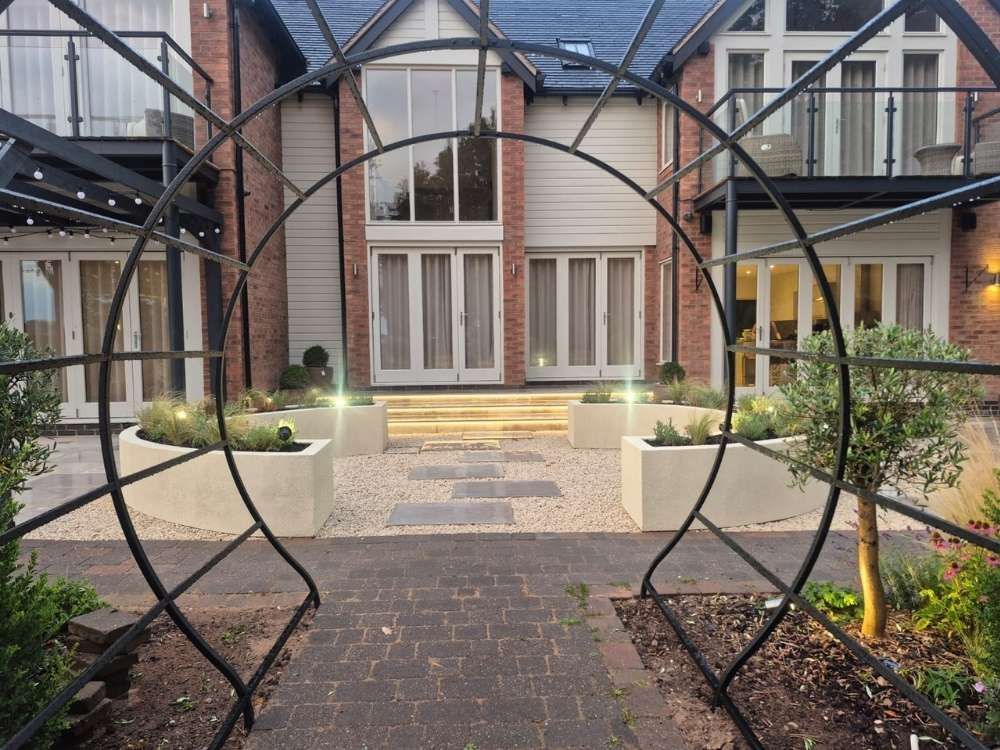
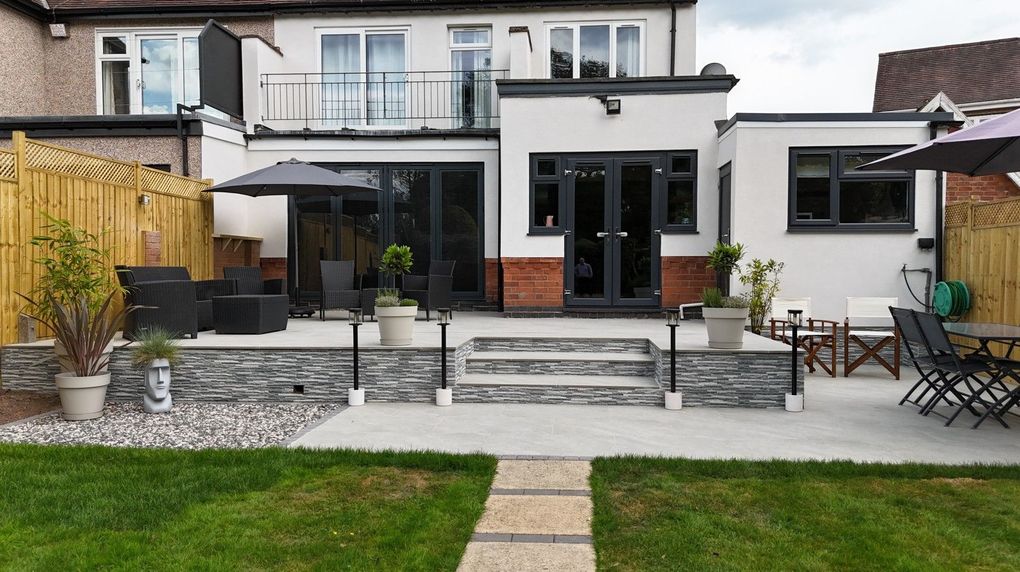
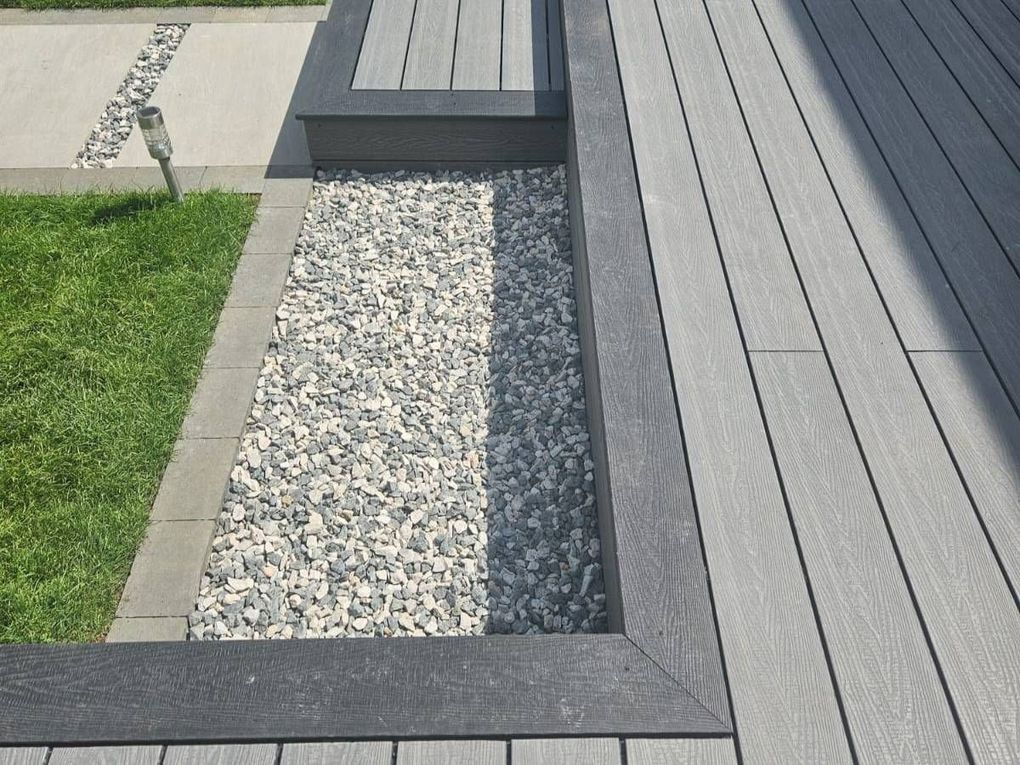
Established gardens need surveying, not guessing
On a mature Kenilworth plot, most of the important information is invisible from the patio doors. How much fall there is between the house and the back boundary. Where the water goes in February. How far the roots of a sixty-year-old tree extend, and what that rules out.
So the first visit is a survey rather than a sales call. Levels, drainage, soil, aspect, the condition of the existing walls and hedges, and what you want the garden to do that it currently does not.
From there you get an outline sketch, a coloured plan and 3D views taken from the rooms you look out of most, with the materials settled before ordering. Once agreed, the figure is fixed and our own team builds it — groundworks, hard landscaping, structures and planting, in one continuous programme rather than a series of visits.
What we find in CV8
Large postwar plots
Much of Kenilworth is detached housing from the 1930s through to the 1970s, on plots considerably larger than anything being built now. The gardens are often two-thirds lawn with a narrow border, which wastes the space. Breaking a big rectangle into rooms — terrace, lawn, planted walk, something at the far end worth reaching — is usually the single biggest improvement available.
Period property near the town centre
Older houses around Abbey End and the Warwick Road bring red sandstone walls, changes in level and, frequently, a listed or conservation context that limits what can be altered. Work here means repairing and keeping the existing fabric wherever possible and choosing materials that sit with local stone rather than against it.
Newer developments
The more recent estates on the edges of the town give the usual combination of compacted ground, minimal topsoil and a fence line that offers no privacy at all until something is planted or built. Ground preparation and boundary treatment are where the early budget goes.
Tall hedges, light and the law
On established plots the most common boundary problem is not a fence but a hedge. Leylandii and other evergreens planted for privacy in the 1980s are now blocking light from a neighbour’s window, and the conversation that follows is rarely comfortable.
The general position on high hedges
- Part 8 of the Anti-social Behaviour Act 2003 lets someone complain to the council about an evergreen or semi-evergreen hedge of two or more trees or shrubs that is over two metres tall and is blocking light or access to their property.
- The council can only act once reasonable attempts to settle it privately have been made, and councils charge a fee to consider a complaint.
- If upheld, a remedial notice can require the hedge to be reduced. It cannot require removal, and it does not apply to a single tree or to deciduous hedging.
That is the general framework rather than advice on your situation, and your local council confirms how it applies. It matters at design stage, because a screening scheme built around an evergreen hedge that later has to come down by a metre is a scheme built on sand.
Old drainage and heavy ground
Larger gardens here often rely on drainage installed decades ago, if at all. The symptoms are familiar: a lawn that stays soft until May, a soakaway that has silted up and now backs up, water standing where a path meets a step.
We tackle that before the surfaces: land drainage giving water a route out, a soakaway sized and sited for ground that will take it, falls set away from the building and enough soil improvement for planting to establish in the first season rather than the third. Our Kenilworth garden drainage page explains the approach, with more detail in our clay soil guide.
Why larger gardens come to us
On an established plot the risk is not how the paving looks on handover day. It is whether the levels, drainage and detailing still stand up in five years.
Surveyed properly before designed
Levels, drainage, soil and root spread established first, so the design works with the garden rather than against it.
One contractor throughout
We run the site and manage any specialist brought in, so accountability never moves.
A figure that holds
Fixed after the design, covering machinery, materials, construction, planting and clearing up.
Established and insured
Building gardens since 2015, £1M public liability, 40+ years of combined experience.
Other areas we work in
Frequently asked questions
Do you work across Kenilworth and CV8?
Yes, throughout Kenilworth and the surrounding area, and across Warwick, Leamington Spa, Balsall Common and Solihull. We take on complete design-and-build schemes rather than individual tasks.
Do you do hedge cutting, grass cutting or general garden tidying?
Only for our own design-and-build clients, for whom aftercare can be tailored after handover. Hedge trimming and routine upkeep for other gardens belong with a maintenance gardener.
My neighbour's hedge blocks all our light. Is there anything that can be done?
There is a process. Part 8 of the Anti-social Behaviour Act 2003 allows a complaint to the council about an evergreen hedge over two metres that blocks light, but only after reasonable efforts to resolve it privately, and councils charge a fee. It is worth knowing about at design stage, because it affects what you can rely on for screening.
Can you design around mature trees?
Usually, and it is generally better than designing them out. Roots extend much further than the canopy suggests, so paving and foundations need to be set out with that in mind, and planting under an established canopy has to cope with dry shade. Where a tree is protected, or sits in a conservation area, consent may be needed before any work to it.
Our garden is large and mostly lawn. Where do we start?
By deciding what the space should do. A large lawn is easy to maintain and rarely used. Dividing it into distinct areas, with a reason to walk to the far end, is what turns square metres into a garden. That is a design conversation before it is a construction one.
Do you work on period and listed properties?
Yes. It calls for restraint: keeping and repairing original walls, choosing materials that sit with older brick and stone, and checking before altering anything that protection might cover. On a listed property that protection often extends to boundary walls and outbuildings, not just the house.
What does the price cover?
Labour, machinery, groundworks, drainage, materials, hard landscaping, structures, planting and removal of waste, as a single agreed figure after the design. Any specialist trade required is arranged and managed by us.
Thinking about your Kenilworth garden?
Tell us what you want from the space and what is holding it back. We will survey it properly and show you the answer in 3D.
