
Garden Drainage Solutions for Waterlogged Gardens
Tell us what your garden does in the wet and we will come and look at the ground
Get on top of your Waterlogged Garden - simply complete the form below:
A waterlogged garden is almost never a mystery. Rain is arriving faster than the ground will accept it, and it has nowhere to go. What varies is why the ground will not take it, and that is what decides whether the answer is a length of pipe, a soakaway, a change of level or all three.
What we install
Land drainage
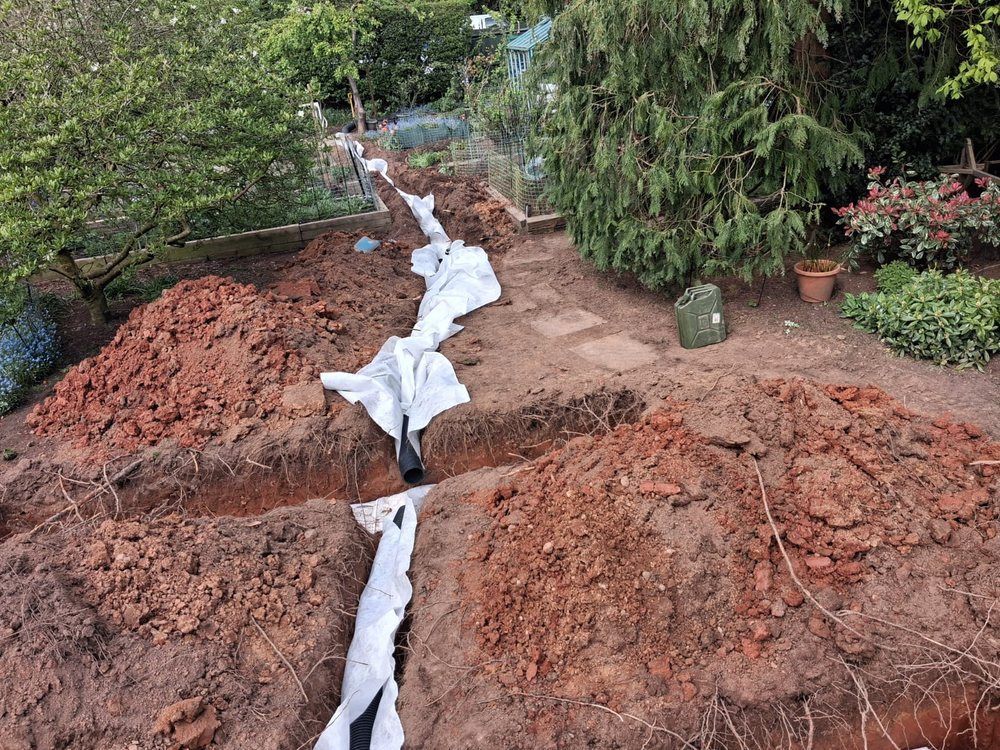
Perforated pipe in membrane-lined, stone-filled trenches, cut to a fall and taken to a legitimate outlet.
Herringbone systems
Branch runs feeding a central spine, for a lawn that is wet across its whole area rather than in one corner.
French drains
A single intercepting line, used where water arrives from one direction such as a slope or a hard surface.
Soakaways
Crate or stone, sized against a percolation test and set at the correct distance from buildings and boundaries.
Soakaway replacement
Silted crates and rubble-filled pits excavated and rebuilt, which is a different job from adding a second one.
Attenuation and routing
Holding water back and releasing it slowly, or moving it, where infiltration is not an option at all.
Levels and falls
Resetting paving and paths that currently shed water towards the house rather than away from it.
Drainage moves the water. Leaving ground that plants will actually grow in is the second half of the work.
One job, from first trench to finished lawn
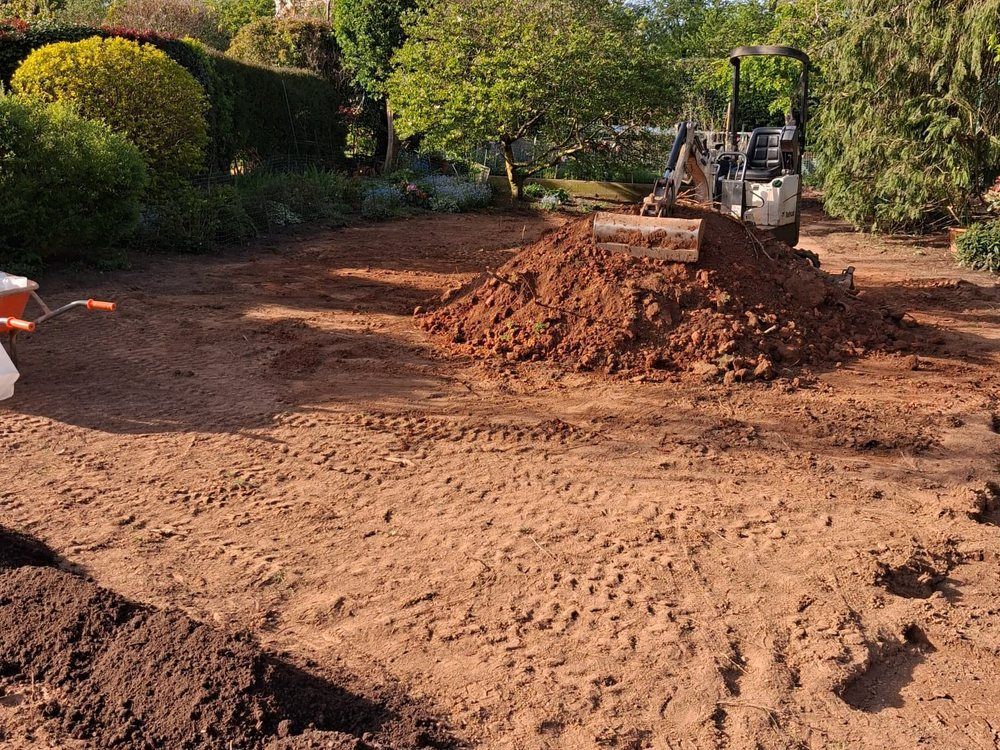
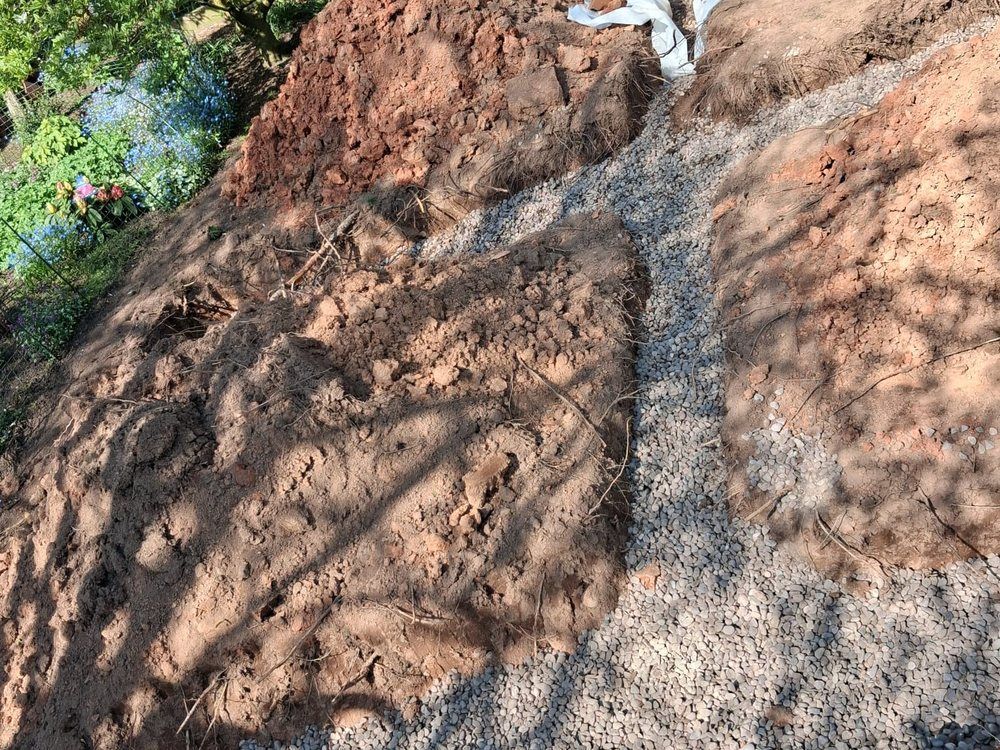
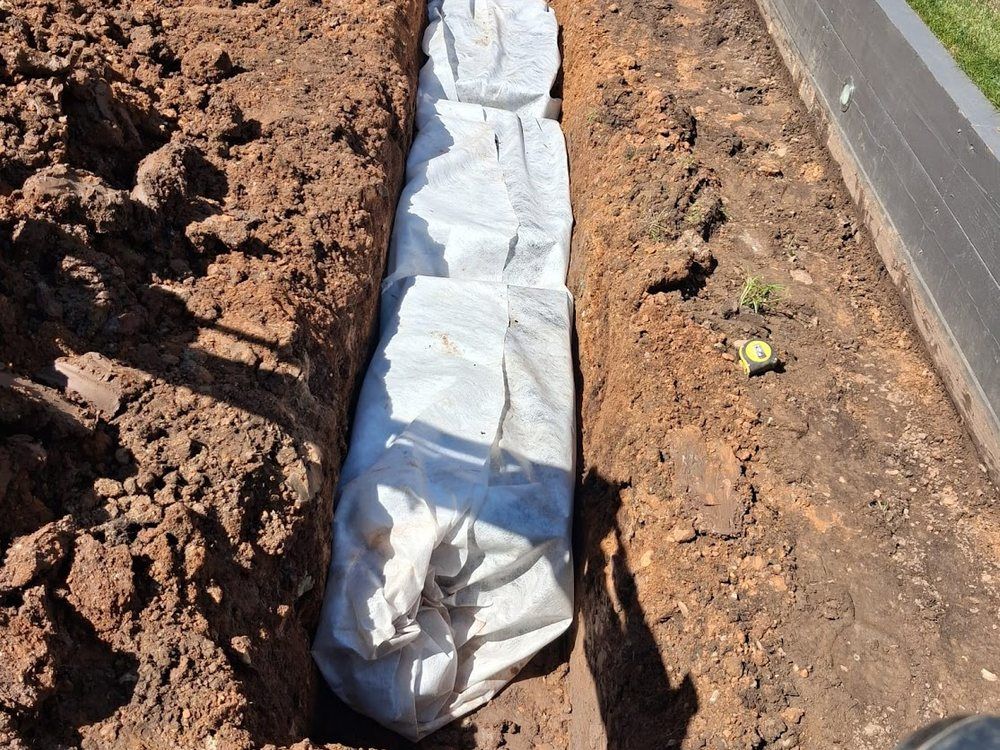
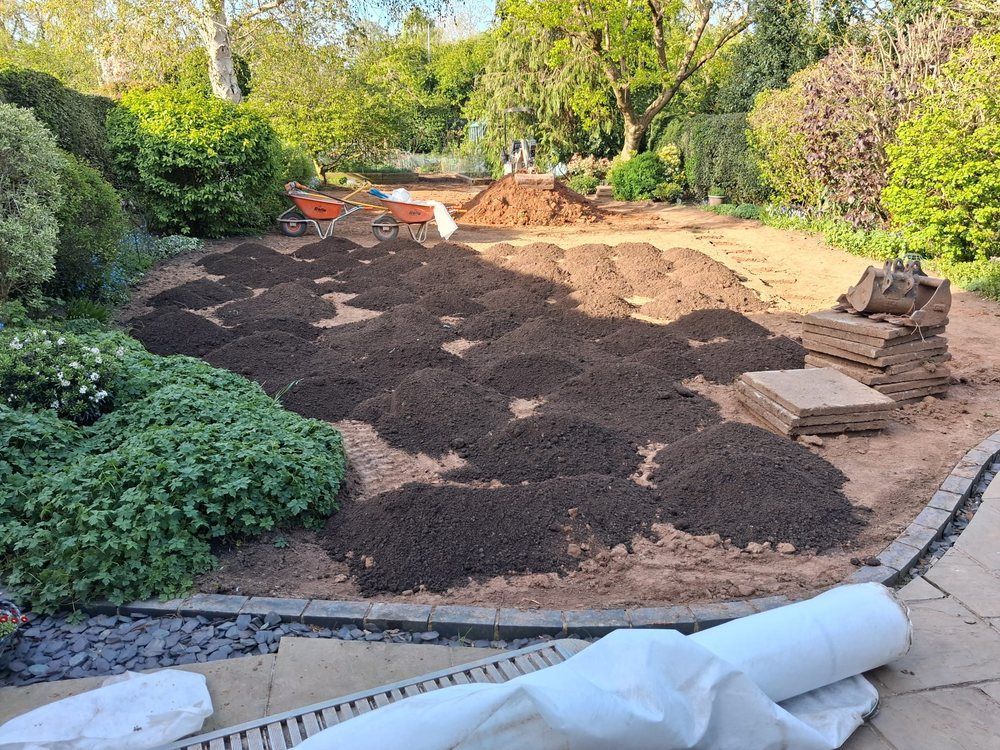
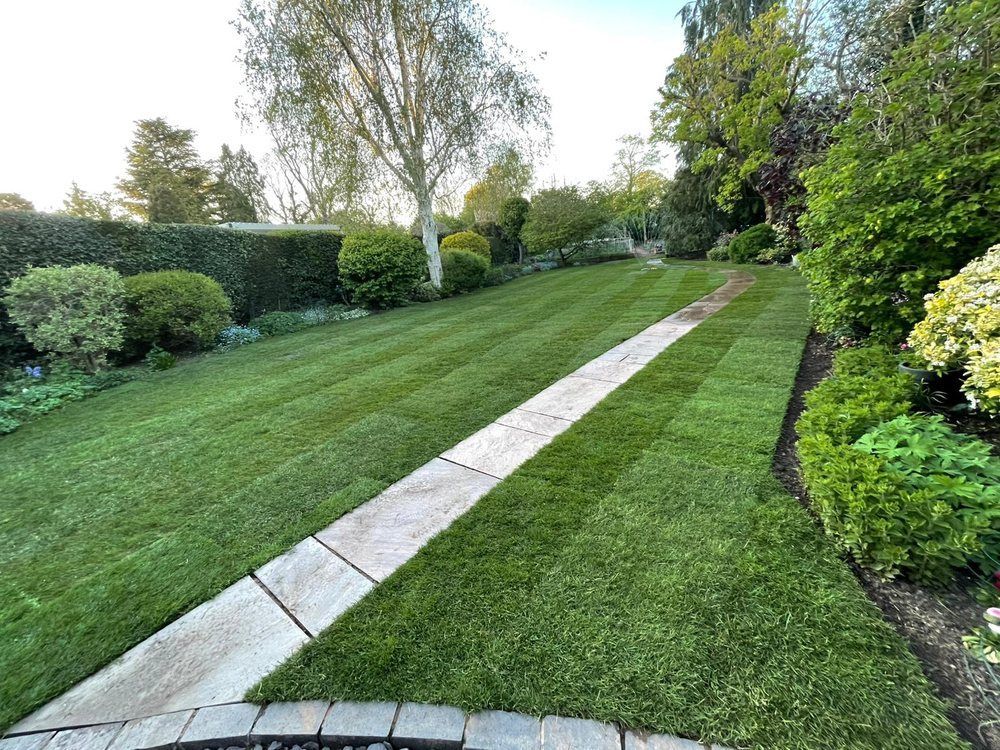
A recent scheme at Kenilworth, photographed through the build. It is the clearest illustration we have of what a drainage job involves and what is left behind afterwards.
Why a garden holds water
There are only four reasons a garden stays wet, and telling them apart matters more than any product you could buy.
The soil will not let water through
Clay is made of particles fine enough to pack together with almost no space between them. Water sits on top because there is nowhere for it to go. Most of the Midlands sits on some version of this, and it is the commonest single cause.
The ground has been compacted
Very common on anything built in the last thirty years. Construction traffic squeezes the subsoil flat, a thin layer of topsoil is spread over it and turf is laid on top. The garden looks finished and drains like a car park.
The water has nowhere to go
Sometimes the soil is fine and the problem is the destination. No surface water drain, no fall, a boundary wall acting as a dam, or a soakaway that silted up years ago and nobody noticed.
The water is coming from below
A high water table or a spring. The giveaway is water present in a dry spell, when rainfall cannot explain it. This one needs a completely different approach, and a soakaway will make no difference at all.
A trial hole and a timed percolation test separate these in about an hour, which is why we do it before quoting rather than after.
How a drainage system is put together
The components are not complicated. Getting them right is what separates a system that works for twenty years from one that stops working in three.
- Fall before depth. Water moves because of gradient, not because the trench is deep. A shallow run laid to a true fall will shift more water than a deep one sitting level.
- Geotextile, always. Without a membrane between soil and stone, fine clay particles wash into the aggregate and fill the voids that were doing the work. This is the single commonest reason a system silts up.
- Clean aggregate, not whatever is in the yard. Washed stone of a consistent size holds open space. Crusher run and as-dug gravel do not.
- Perforated pipe the right way up. Slots take water in. Their orientation and the depth of stone above and below them are both deliberate.
- A real outlet. A drainage run that discharges into a hole in the clay has moved the problem four metres. There has to be somewhere the water can actually leave.
Where water may legally be discharged
Most people are surprised that this is regulated at all. It is, and the rules exist because badly disposed surface water causes flooding somewhere else.
The general position in England
- Infiltration first. Part H of the Building Regulations sets a hierarchy for rainwater and surface water — into the ground, then to a watercourse, then to a sewer — and expects each option to be ruled out before the next is used.
- Never into a foul sewer. Clean water in a foul drain overloads treatment works and contributes directly to sewer flooding.
- Sewer connections are applications. Section 106 of the Water Industry Act 1991 gives a right to connect, exercised through the water company rather than assumed.
- Watercourses need consent too. Putting a new outfall into a ditch or brook calls for land drainage consent, granted by whichever authority holds the flood-risk role locally, under the Land Drainage Act 1991. It is not available retrospectively.
- Soakaways have setbacks. Guidance keeps them at least five metres from a building and roughly two and a half metres from a boundary, sized from a BRE Digest 365 percolation test.
- Not onto a neighbour. Channelling collected water over a boundary is treated very differently from water that arrives there naturally.
We install drainage; we are not drainage consultants or solicitors, and none of the above is advice about a specific property. What we do is identify at survey which permissions a scheme is likely to need, so they are dealt with at the start rather than discovered later. The clay soil guide goes further into why this ground behaves as it does.
What a drainage scheme is priced on
We do not quote from a photograph or a phone call, because the honest figure depends on things that are only visible once the ground is open. What moves it:
- The outlet. An existing surface water drain in a sensible position is the cheap outcome. A tested, sized soakaway or a consented outfall is not.
- Length and layout. One intercepting run is a fraction of a full herringbone.
- Access. Whether a machine can reach the working area is usually the single biggest variable in the labour.
- Spoil. Clay is heavy, it cannot be spread on the garden, and every load of it leaves by lorry.
- Reinstatement. Turfing a lawn is quick. Putting back mature planting, paving and edging is not.
Once the garden has been seen, a single quotation covers people, machinery, digging, every material, the removal of what comes out and the restoration of what is disturbed.
How we work
Drainage is bought on trust, because within a week of finishing there is nothing left to inspect. These are the commitments that go with every scheme.
Nothing is quoted from the doorstep
An hour with a spade and a stopwatch establishes what the ground will accept, and that single figure shapes every decision that follows.
We will tell you when it will not work
Some ground cannot take a soakaway and some problems are not rainfall at all. Saying so loses us work and saves you paying twice.
Guaranteed, and built to outlast it
Every scheme carries a 12-month workmanship guarantee, and membrane, washed aggregate and a true fall on every run mean it keeps working long after.
Landscapers, not groundworkers
Soil, grass, borders and paving are restored under the same agreement, so the garden is handed over finished rather than merely drained.
Garden drainage by area
Frequently asked questions
How do I know whether I need land drainage or a soakaway?
They do different jobs and most schemes use both. Land drainage collects water from across an area and moves it. A soakaway is one of the places that water can be delivered to. If the ground will accept water at a useful rate you can often use a soakaway as the destination; if it will not, the collected water has to go somewhere else entirely.
Will spiking or aerating the lawn fix it?
For mild surface compaction on ground that otherwise drains, aeration genuinely helps and is worth trying first. On clay it buys a few weeks. Spiking creates holes a few inches deep in a material that does not transmit water sideways, so the holes fill and the problem returns.
Can you raise the level instead of digging?
Sometimes, and it is a legitimate approach for beds and borders where building up with imported soil puts the roots above the wet. It does not work for a lawn or a whole garden, it raises levels against the house, and it can push water onto a neighbour. We would rather deal with the water than build over it.
How long does garden drainage take?
Most domestic schemes run from a few days to a fortnight. Access drives it more than size: where a machine can work the excavation is quick, and where everything moves by barrow the same job takes several times as long.
Do I need permission to install garden drainage?
For a system contained within your own garden and discharging to a soakaway on your own land, usually not. Connecting to a public sewer or putting a new outfall into a ditch or brook both need permission, and a soakaway taking roof water from an extension falls under Building Regulations. We flag anything that applies before work begins.
What happens to the lawn while you work?
It looks considerably worse than the problem did, for a few days. Trenches cross the grass, spoil is stacked and the garden is a building site. Then topsoil goes back, turf or seed goes down, and within a season there is nothing to see.
Is your drainage work guaranteed?
Yes. All of our build work, drainage included, carries a 12-month workmanship guarantee. Just as importantly, we design from a measured percolation test rather than an assumption, and we will decline a scheme we do not believe will work rather than take the money.
What does garden drainage cost?
There is no useful average, because the same wet lawn can be a modest job or a substantial one depending on where the water is allowed to go and whether a machine can reach it. We survey, test the ground, and then give one figure that covers everything from the excavation to the turf.
Not sure what is wrong with your garden?
Most people are not, and that is what a survey is for. Tell us what the garden does in the wet and we will come and find out why.
