
Garden Drainage and Soakaways in Kenilworth
Land drainage, herringbone systems and soakaways built for Warwickshire clay
If your lawn holds water into spring, if paths stay slick and green all winter, or if a soakaway that used to cope has quietly stopped, it is the same problem in every case: rain arriving faster than the ground will take it. We survey, dig and drain gardens across Kenilworth and CV8, and every photograph on this page is from one job here.
Drainage work we carry out in Kenilworth
Perforated pipe in stone-filled, membrane-lined trenches, falling to somewhere the water can actually go.
Side runs feeding a central spine. The right answer where a whole lawn sits wet rather than one corner.
A single intercepting run, used where water arrives from one direction — a slope, a boundary, a patio edge.
Soakaway installation
Crates or stone, sized against a percolation test rather than guessed, and set the right distance from the house.
Soakaway replacement
Old rubble-filled pits and silted crates that have stopped taking water, dug out and rebuilt.
Drainage fixes the water. Soil that plants will actually grow in is a separate job, and we do both.
Levels and falls
Patios and paths reset to shed water away from the building instead of holding it against the wall.
Topsoil back, new turf or seed down, borders put right. You should not be able to see where we worked.
A Kenilworth drainage job, in order
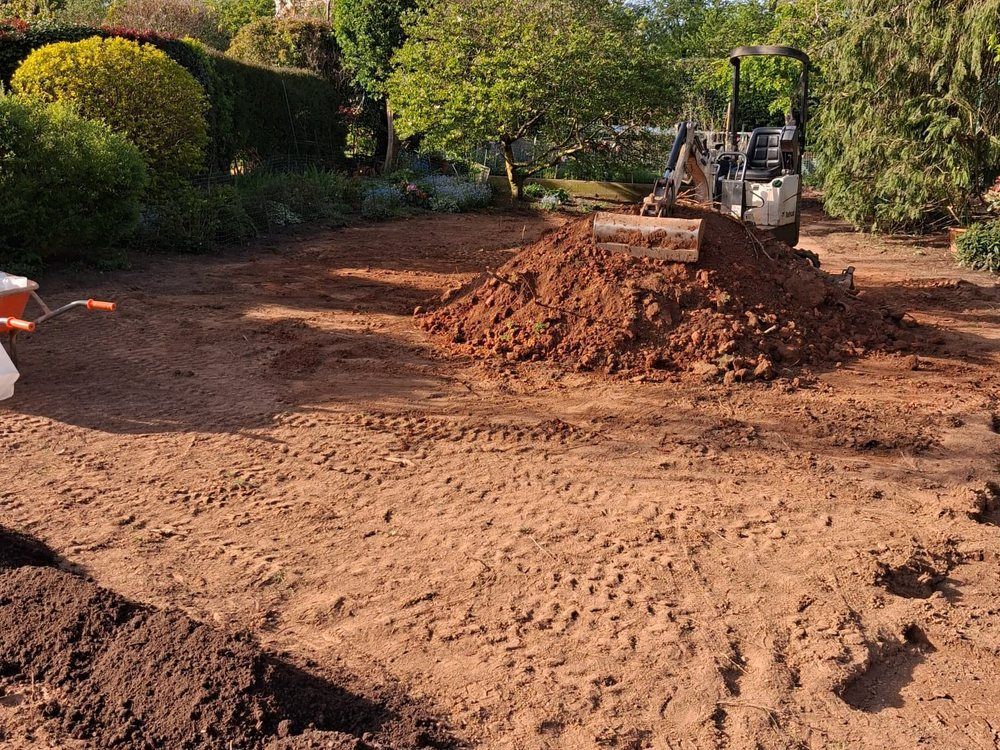
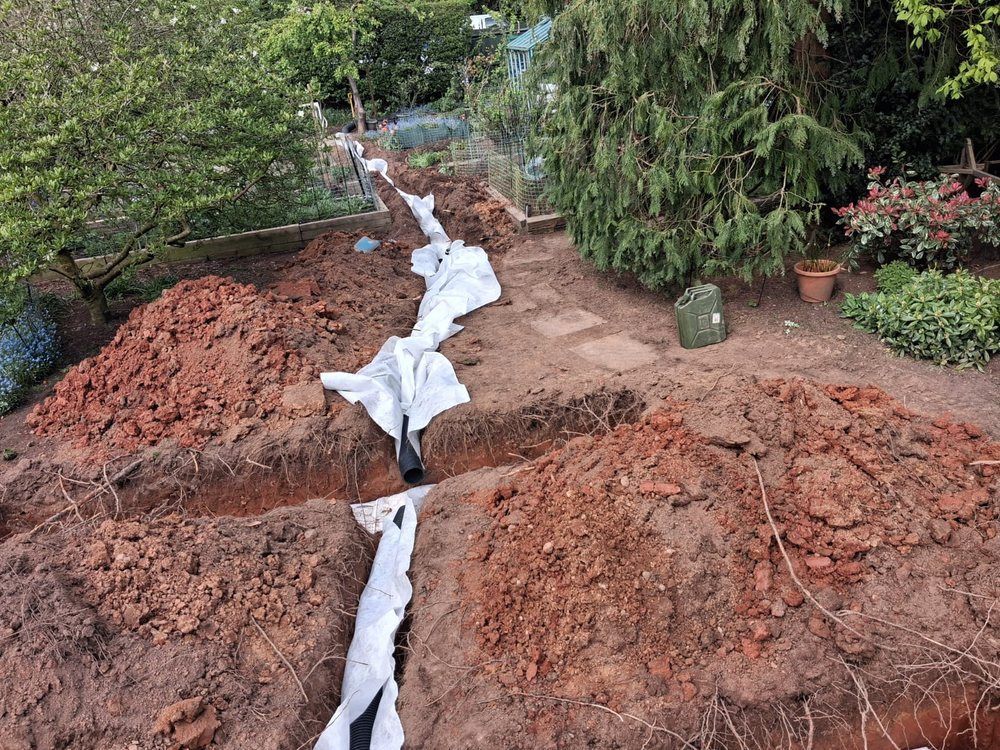
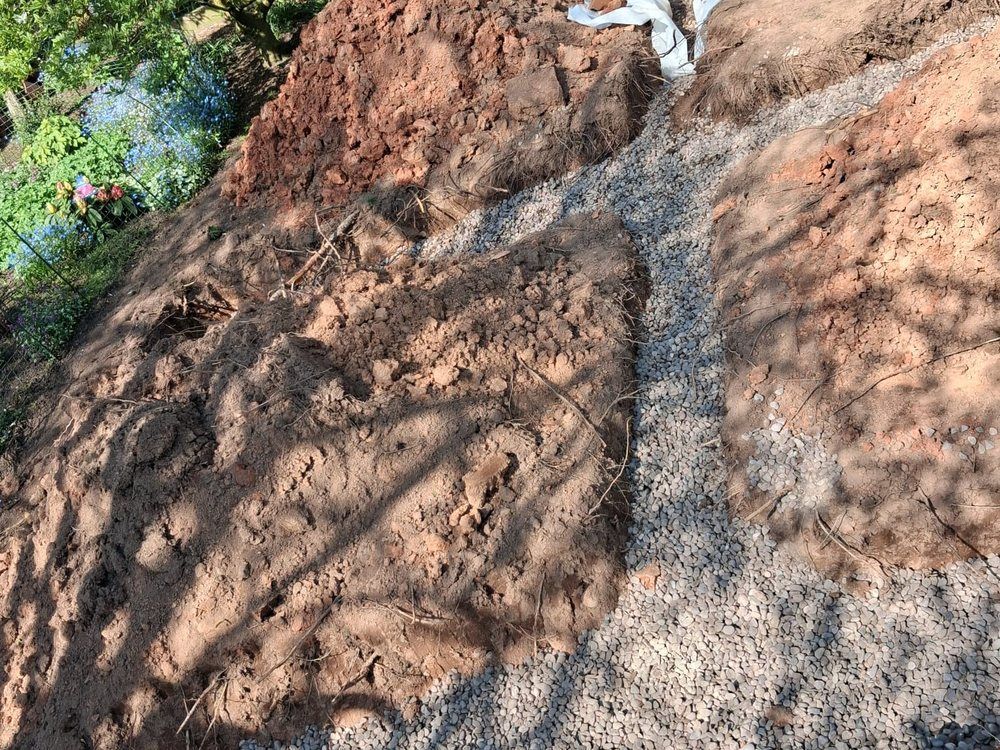
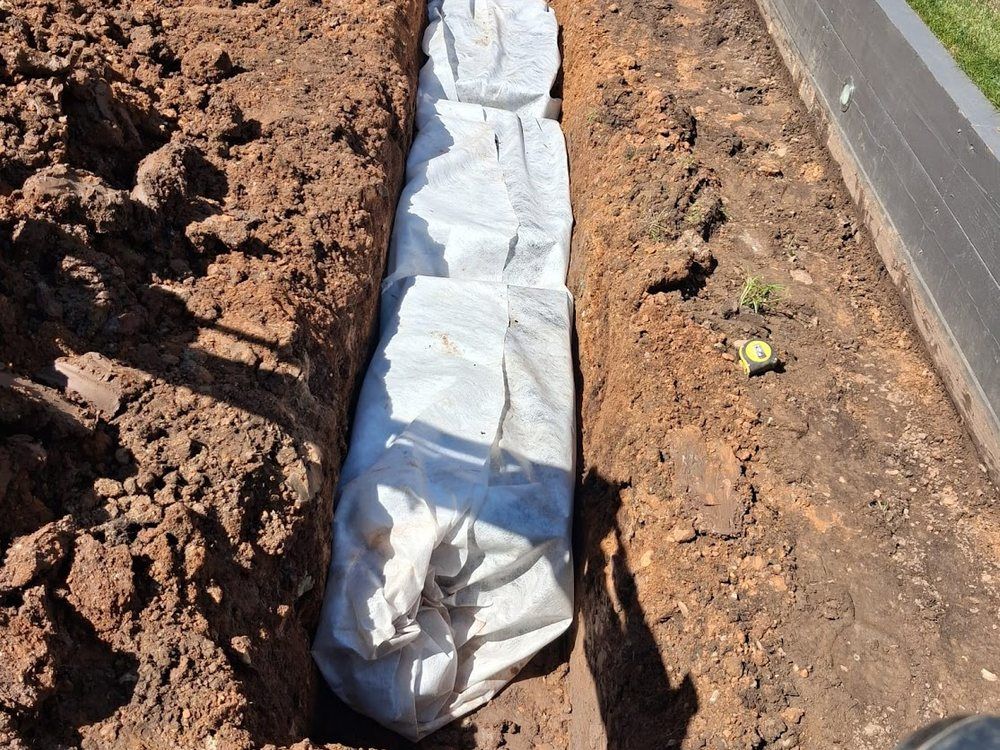
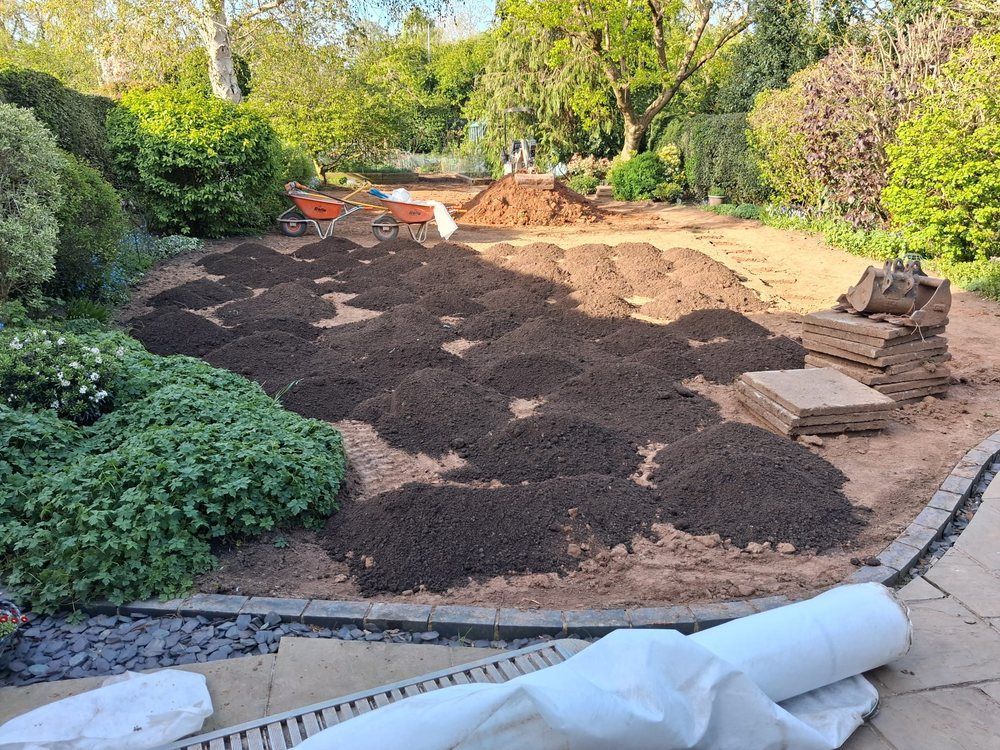
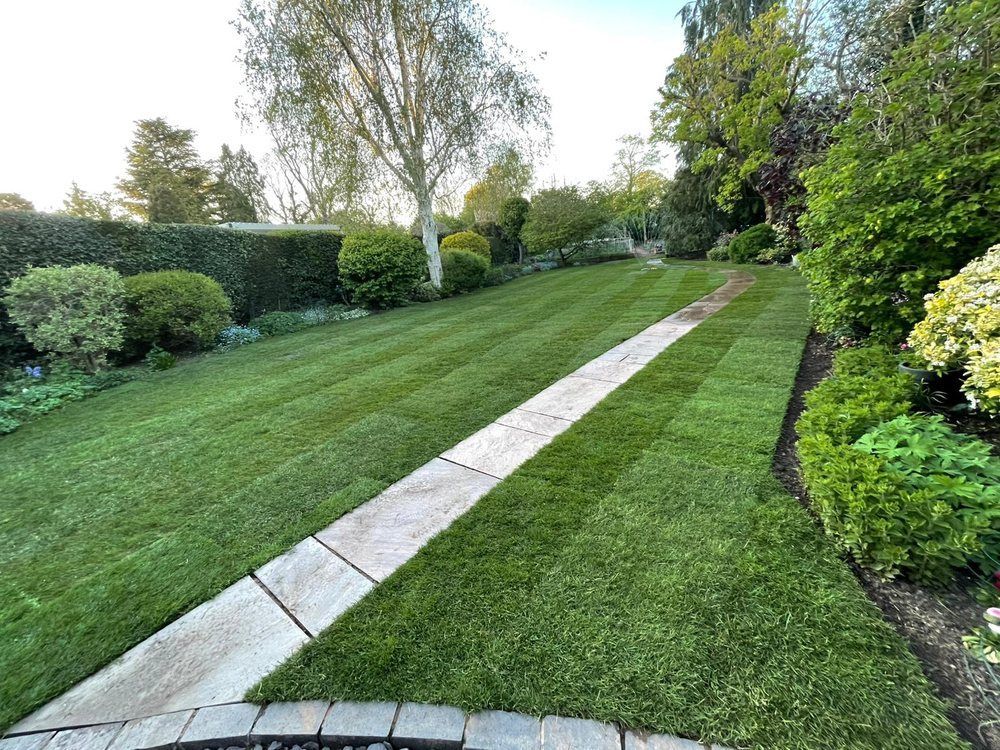
Six photographs from the same garden, from the first trench to the finished lawn.
Why Kenilworth gardens hold water
Kenilworth sits on the red marl that runs under most of central Warwickshire, and you can see it in the photographs above — dense, orange-red clay a spade’s depth down, with almost no structure to let water through. In a dry summer it sets hard and cracks. In a wet winter it behaves like a saucer.
Three things make it worse here than the geology alone would suggest. Gardens are large and mature, so there is often no obvious low point and no convenient boundary to drain towards. Established trees and thick hedging draw enormous volumes out of the ground through summer and nothing at all through winter, which is why a lawn can be fine in August and standing in water by November. And in the older parts of town, original clayware drainage laid decades ago is frequently still in the ground, cracked, root-filled or simply lost, doing very little.
None of that is fixed by aerating the lawn or by laying a different surface on top. It needs a route out of the garden that works under gravity, and somewhere at the end of it that can take the water.
What actually goes in the ground
Every job starts the same way: we look at where water collects, where it comes from, and what the ground does with it. On clay that usually means digging a trial hole and watching how long it takes to drain, because the answer decides whether a soakaway is viable at all.
Land drainage and herringbone systems
Trenches are dug to a fall, lined with geotextile membrane, part-filled with clean aggregate, and perforated pipe laid in and covered. The membrane is not optional — without it, clay particles migrate into the stone and the system silts up within a few seasons. A herringbone layout puts side runs into a central spine so a whole lawn is collected rather than one wet corner, which is what you can see backfilled in the photographs above.
Soakaways
A soakaway only works if the surrounding ground will accept water at a useful rate. That is what a percolation test establishes, and it is why a crate dropped into stiff clay with nowhere to disperse to is a hole that fills up and stays full. Where the ground will take it, modern crate systems hold far more water per cubic metre than a rubble-filled pit and can be sized properly against the roof or garden area draining into them.
Falls, surfaces and making good
A surprising number of wet-garden problems are a paving fall running the wrong way. Resetting levels so hard surfaces shed water away from the building is often cheaper than draining the consequences. Once the drainage is in, topsoil goes back, turf or seed is laid, and borders are reinstated.
Where the water is allowed to go
This is the part most quotes skip, and it is the part that causes trouble later. There are rules about where garden and surface water may be discharged, and they are not a formality.
The general position in England
- There is an order of preference. Part H of the Building Regulations sets out a hierarchy for rainwater and surface water: soak it away into the ground first; if that is not feasible, to a watercourse; and only then to a sewer. You are expected to work down the list rather than pick the easiest option.
- Land drainage must not go into a foul sewer. Clean water in a foul drain overloads treatment and contributes to sewer flooding. It is the connection most likely to cause a problem with the water company, and on Kenilworth properties the sewerage undertaker is Severn Trent.
- Connecting to a public sewer usually needs consent. A right to connect exists under Section 106 of the Water Industry Act 1991, but it runs through an application to the water company, not a spade and an optimistic afternoon.
- Soakaways have setbacks. The usual guidance is a minimum of five metres from any building and around two and a half metres from a boundary, with the size worked out from a percolation test carried out to the BRE Digest 365 method.
We are landscapers, not drainage consultants or solicitors, and the above is the general position rather than advice about your property. Where a scheme looks likely to need building control involvement or a connection application to Severn Trent, we will say so before we start rather than after. Our garden drainage service page covers the methods in more detail, and the clay soil guide explains why Warwickshire ground behaves the way it does.
What drives the price
Garden drainage is priced from what the ground turns out to be, which is why we survey before quoting rather than giving a figure over the phone. The things that move a price are consistent:
- How much pipe. A single intercepting run along one boundary is a different job from a herringbone across a large lawn.
- Access. A garden a machine can reach is far cheaper to drain than one where every barrow of clay comes out through the house.
- Depth and what comes out. Clay is heavy, and spoil from a drainage job cannot be spread on the garden. It has to be carted away, and that is a real cost.
- Where the water ends up. An existing surface water drain in a sensible position is the cheap outcome. A soakaway that has to be dug, tested and sized is not.
- Reinstatement. Turfing a lawn back is straightforward. Putting back mature planting, paths and edging takes longer.
Whatever the scheme, the figure we give after the survey covers the crew, the machine, the excavation, all materials, every load of spoil taken away, and putting the garden back.
Why people call us for drainage rather than a groundworker
Drainage is the one garden job where the evidence of whether it was done properly is buried. These are the four things clients tell us mattered.
We dig before we quote
Nobody can tell you what your garden needs from a photograph. We open a trial hole, watch how the ground drains and price from what is actually there.
Membrane, aggregate, falls
The three things that decide whether a system is still working in ten years, and the three things most commonly skimped. We do not skip them.
We put the garden back
We are landscapers first. Topsoil, turf, planting and edging are part of the job, not a separate trade you have to find afterwards.
Established and insured
Working across Warwickshire since 2015, with £1M public liability and more than 40 years of combined experience on the team.
Other areas we drain
Frequently asked questions
Do you cover Kenilworth and the villages around CV8?
Yes. We work across Kenilworth, Burton Green, Leek Wootton, Stoneleigh and the surrounding villages, as well as Warwick, Leamington Spa, Balsall Common and Coventry. Drainage is one of the services we are called out for most often on Warwickshire clay.
Can I just run garden drainage into the drain at the side of the house?
Usually not, and it is worth checking which drain it is before anyone connects anything. Land drainage must not go into a foul sewer, and a connection to a public surface water sewer normally needs an application to the water company, which for Kenilworth is Severn Trent. Where a garden already has a surface water drain in a sensible position we will use it. Where it does not, a soakaway is generally the first option under the Building Regulations hierarchy.
How deep does land drainage need to be?
It depends on the fall available and what the trench has to pass under, but a typical garden run sits somewhere between half a metre and a metre deep. Depth matters far less than fall: a shallow trench with a consistent gradient will out-perform a deep one that is level.
Do I need permission or building control for a soakaway?
For a straightforward garden soakaway serving the garden itself, usually not. Where a soakaway takes roof water from an extension or new build it falls under Part H of the Building Regulations and building control will want it sized and tested. The usual guidance keeps a soakaway at least five metres from any building. We will flag anything that looks likely to need sign-off before work starts.
My soakaway used to work and now it does not. What has happened?
Most commonly it has silted up. A soakaway built without a geotextile wrap gradually fills with fine clay particles carried in by the water, and the voids that were doing the work disappear. Old pits simply filled with rubble do the same thing faster. In both cases the fix is to dig it out and rebuild it properly rather than to add another one alongside.
How much of the garden gets dug up, and how long does it take?
More than people expect while it is happening, and less than they fear once it is finished. Trenches are narrow but they cross the lawn, so the garden looks dramatic for a few days. Most domestic schemes run between three days and two weeks depending on access and how much pipe goes in. The photographs on this page are the same garden before, during and after.
What does garden drainage cost in Kenilworth?
We do not quote a figure before seeing the ground, because on clay the honest answer depends on how the soil drains, how far the water has to travel and whether a machine can get in. What we can say is that the price we give after the survey is the price: crew, machine, excavation, materials, spoil removal and reinstatement all included.
Standing water in a Kenilworth garden?
Tell us where it collects and how long it sits. We will come and look at the ground before anyone talks about a price.
