
Soakaways and Garden Drainage in Bedworth
Diagnosing why a soakaway has stopped working, and building one that will not
A large share of the soakaway calls we take in Bedworth are not about installing one. They are about a soakaway that used to cope and does not any more, or one that was never really a soakaway in the first place. Working out which of those you have is the whole job, and it takes about an hour.
Drainage work we carry out in Bedworth
Soakaway installation
Crate systems sized against a percolation test and set the required distance from the house and boundary.
Soakaway replacement
Failed pits and silted crates excavated and rebuilt, which is what most of this work actually is.
Perforated pipe in membrane-lined, stone-filled trenches, collecting water from across the wet area.
Branch runs into a central spine, where the whole lawn is affected rather than one patch.
A single intercepting run for water arriving from one direction.
Drainage investigation
Finding out where your rainwater currently goes, and whether whatever it goes into still works.
Levels and falls
Hard surfaces reset to shed water away from the building rather than hold it against the wall.
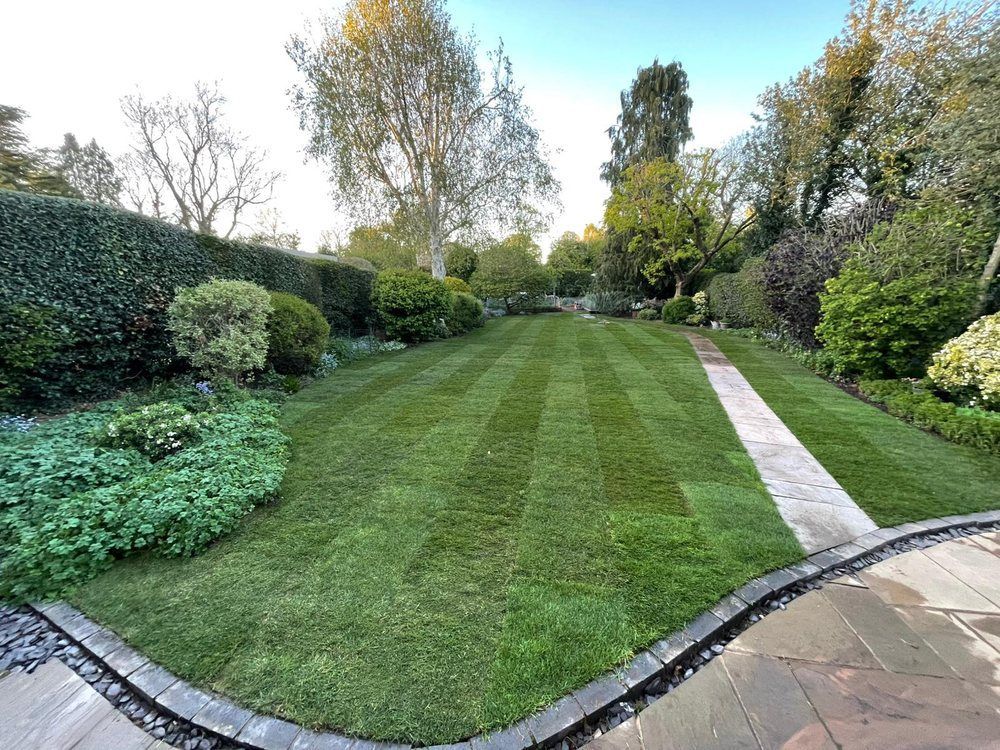
Soil, grass and borders restored so the garden does not look recently dug.
What the work involves
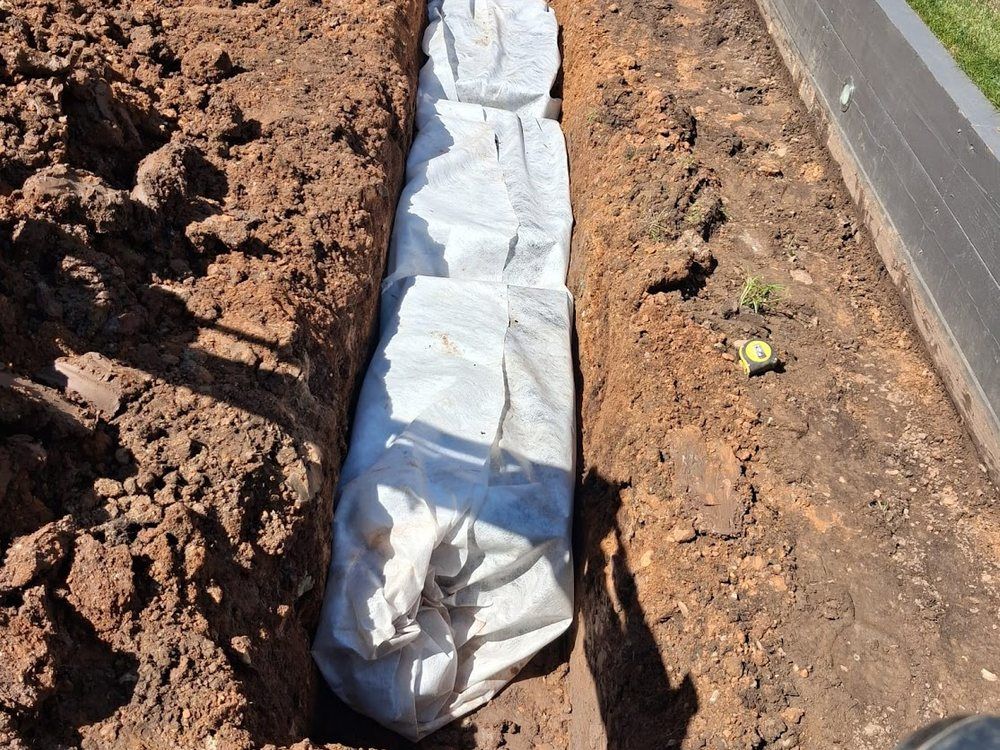
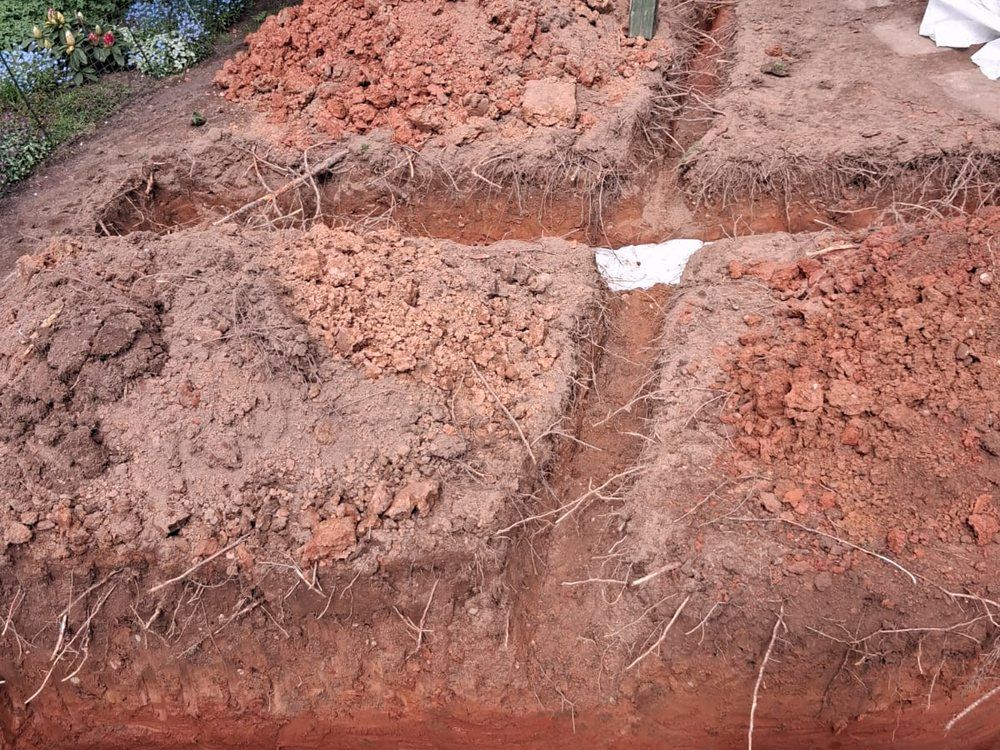
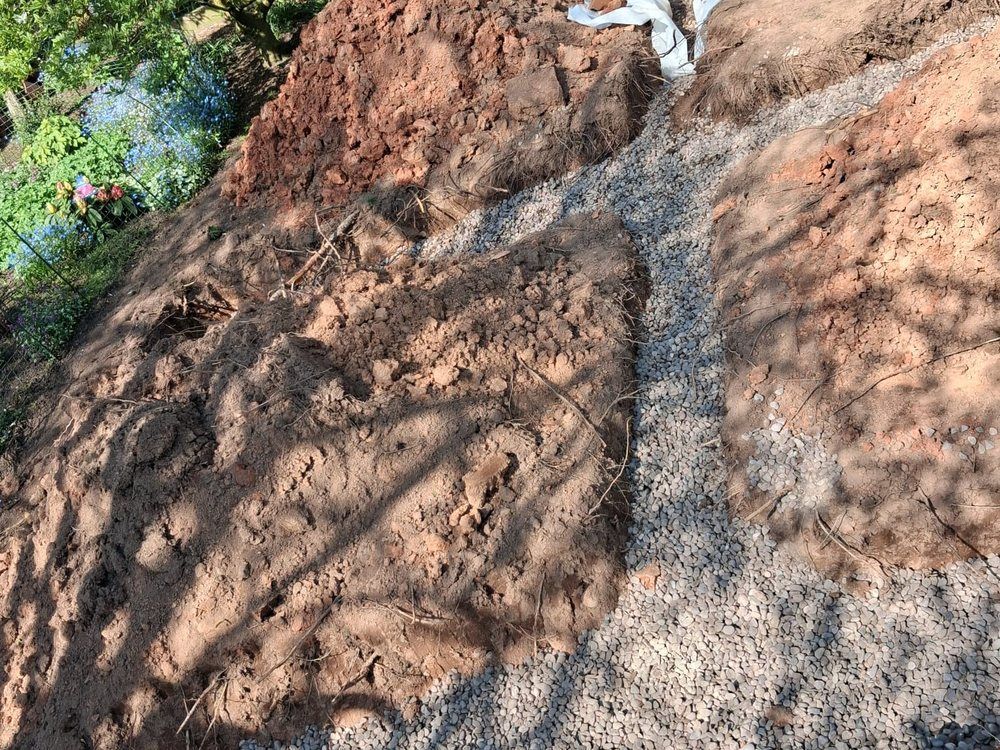
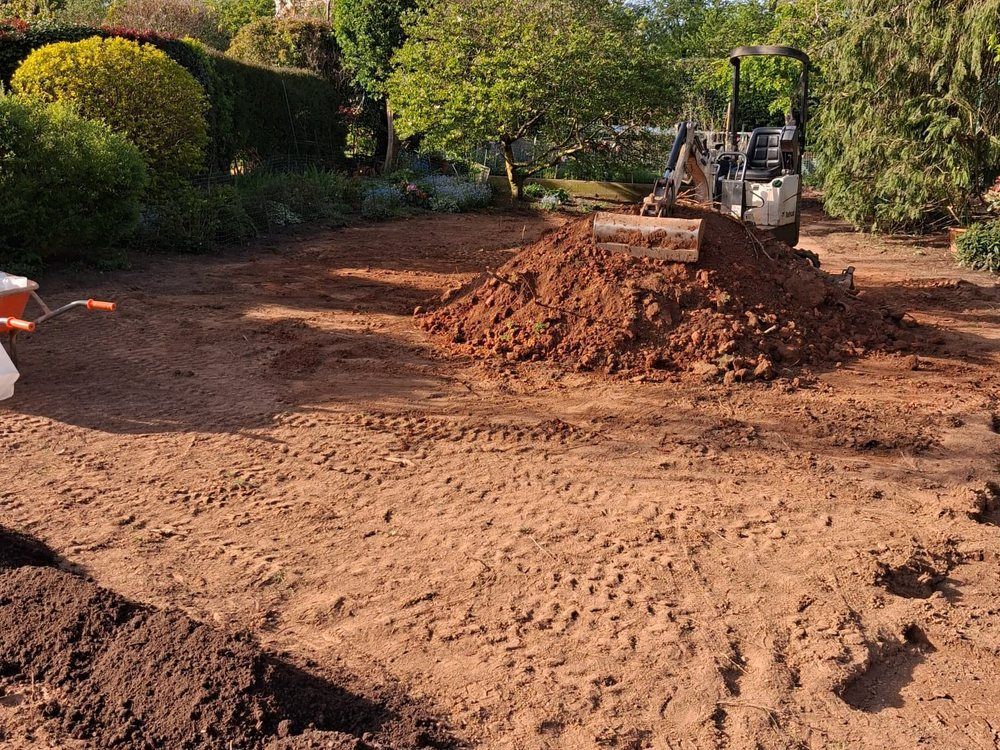
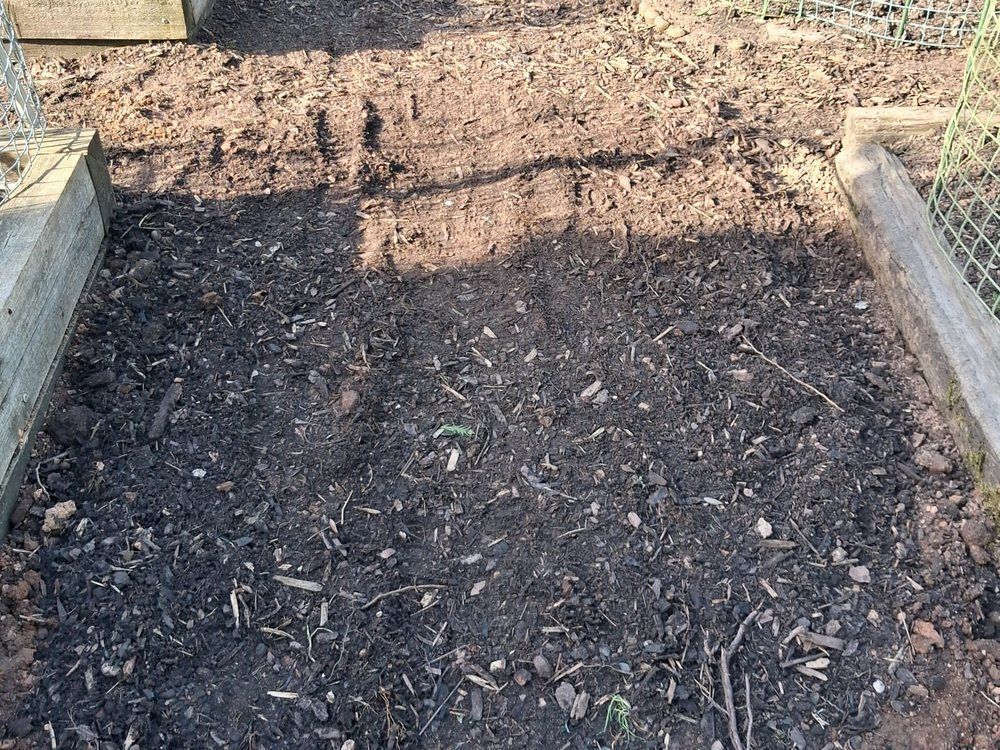
Photographs from a recent scheme at Kenilworth, including the part most people never see: a crate soakaway being wrapped and bedded before it disappears.
Three things sold as soakaways, only one of which is
The word covers a lot of ground, and what is buried in a Bedworth garden depends largely on when it went in.
A hole filled with rubble
Common in older gardens and still occasionally installed. Broken brick and hardcore in a pit, sometimes with nothing separating it from the surrounding soil. It works briefly, then fine clay particles wash into the gaps and fill them. Most of these stopped functioning decades ago and nobody noticed because the garden drained slowly rather than not at all.
A crate with no wrap
Modern plastic crates hold far more water per cubic metre than rubble, which is why they are used. Installed without a geotextile wrap they silt up exactly the same way, only from a larger starting volume, so they take five or ten years to fail rather than two.
An actual soakaway
Wrapped, sized against a measured percolation rate, set the correct distance from buildings and boundaries, and discharging into ground that will genuinely accept water. This is the one that is still working in twenty years.
Telling them apart usually means digging down to it, and that is a morning’s work rather than a project.
Before you replace it, find out whether it is the right problem
Replacing a soakaway that was never the cause of the wet lawn is an expensive way to change nothing. There is a simple way to narrow it down.
Two questions worth answering first
- Is the water there in dry weather? If ground is wet during a settled dry spell, rainfall does not explain it. That points to groundwater or a spring, and no soakaway will make any difference at all.
- Does the wet area relate to a downpipe? A roof sheds an enormous volume, and a downpipe going into a failed soakaway or simply discharging at the base of a wall concentrates all of it into one spot. If the wet patch sits near a downpipe, start there.
- Will the ground take water on a good day? A trial hole filled with water and timed tells you whether infiltration is available at all. If the hole is still full the next morning, the ground is the constraint and a bigger soakaway will not overcome it.
- Is there an outlet nobody has looked at? On many older properties there is drainage in the ground that has never been traced, and it may be doing nothing simply because it is blocked.
Where a soakaway is genuinely the answer, the usual guidance keeps it at least five metres from a building and about two and a half metres from a boundary, sized from a BRE Digest 365 percolation test. Where it is not, we will say so rather than sell you one. Our drainage service page covers the alternatives.
Building one that lasts
A replacement is excavated fully rather than topped up. The failed material comes out, because leaving silted rubble in the base of a new excavation simply seals the bottom of it. The void is lined with geotextile on all faces including underneath, crates or clean washed stone go in, the wrap is lapped over the top, and the whole thing is covered with a layer of soil deep enough to plant or turf over.
The inlet arrives through a silt trap or a catchpit wherever practical, because the fine material that kills a soakaway mostly arrives in the water rather than through the sides. Where roof water is involved, the downpipe connection is dealt with at the same time.
What a soakaway job is priced on
- Size, which comes from the test. The area draining into it and the rate the ground accepts water between them set the volume.
- Depth and what comes out. A soakaway excavation produces a great deal of clay, and none of it can stay.
- Access for a machine. Hand-digging a soakaway is possible and slow, and the price difference is considerable.
- Whether collection is needed too. A soakaway is a destination. If water also has to be gathered from across the lawn, that is a second element.
- What is already in the ground. Removing a failed system is part of the work and adds to the spoil.
Once surveyed, a single figure covers the crew, the machine, the digging, all materials, every load taken away and the garden reinstated.
Why Bedworth clients use us for soakaways
Soakaways fail invisibly, which makes them easy to sell badly. Our approach is to establish what is actually wrong before quoting for anything.
We dig down to the existing one
Guessing why a soakaway failed is guessing. Looking at it takes a morning and changes what we recommend about half the time.
We will tell you it is not the soakaway
Groundwater, a downpipe or a blocked outlet are all common, and none of them is fixed by a bigger hole.
Wrapped on every face
Including the base. It is the single detail that decides whether a soakaway lasts two decades or five years.
Local and insured
Working across Bedworth, Nuneaton and Warwickshire since 2015, with £1M public liability cover.
Drainage in nearby towns
Frequently asked questions
Do you cover Bedworth and the surrounding area?
Yes. We work across Bedworth, Bulkington, Exhall and Keresley, and on into Nuneaton, Coventry and the villages between them.
How do I know whether my soakaway has failed?
The usual sign is water standing near where it should be disappearing, or a downpipe backing up in heavy rain. The reliable way to know is to dig down to it. If it is a rubble pit it has almost certainly silted; if it is a crate without a geotextile wrap it is on the same path. That inspection takes a morning and tells you whether replacement is worthwhile.
Can you just make the soakaway bigger?
If the ground accepts water and the existing one is simply undersized, yes. If the ground will not take water at a useful rate, a larger soakaway holds more water for longer and still does not dispose of it. The percolation test is what separates those two situations, and it is worth doing before committing to an excavation.
My garden is wet even in dry weather. Is that still a soakaway problem?
Almost certainly not. Water present during a settled dry spell is not rainfall, which points to groundwater or a spring. That needs a different approach entirely, usually interception and routing rather than infiltration, and installing a soakaway would be money spent on the wrong problem.
What is a silt trap and do I need one?
A small chamber in the line before the soakaway that lets fine material settle out rather than being carried into the void. It is not always essential, but on a system taking surface water off a garden it significantly extends the life of what it feeds, and it can be rodded and cleaned, which a buried soakaway cannot.
How far from the house does a soakaway have to be?
Guidance generally puts it at least five metres from any building and around two and a half metres from a boundary, with the capacity worked out from a BRE Digest 365 percolation test. On a smaller plot those distances can be the constraint that decides the design, so it is worth measuring early.
What does a soakaway cost in Bedworth?
It depends on the volume the test says you need, whether a machine can reach the position, and whether a failed system has to come out first. We survey and test before quoting, and the figure then covers excavation, materials, spoil removal and reinstatement.
Soakaway stopped working in Bedworth?
Tell us where the water sits and whether it relates to a downpipe. We will dig down to what is there before recommending anything.
