
Garden Drainage and Soakaways in Hinckley
Land drainage, soakaways and sorting out roof water that is going where it should not
A surprising number of wet gardens in Hinckley are not really garden problems at all. They are roof problems — hundreds of square metres of tile shedding into a downpipe that discharges somewhere unhelpful, or into a drain that should never have received it. Working out where your rainwater currently goes is usually the cheapest thing we do.
Drainage work we carry out in Hinckley
Downpipe and roof water
Getting hundreds of square metres of roof discharge to somewhere it can actually go.
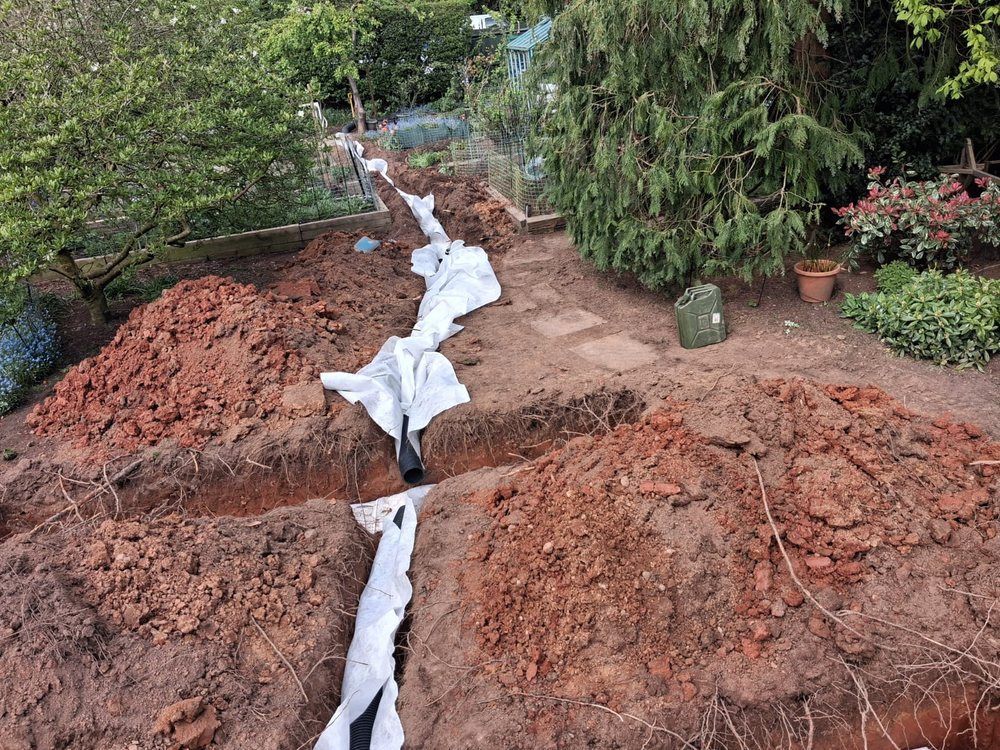
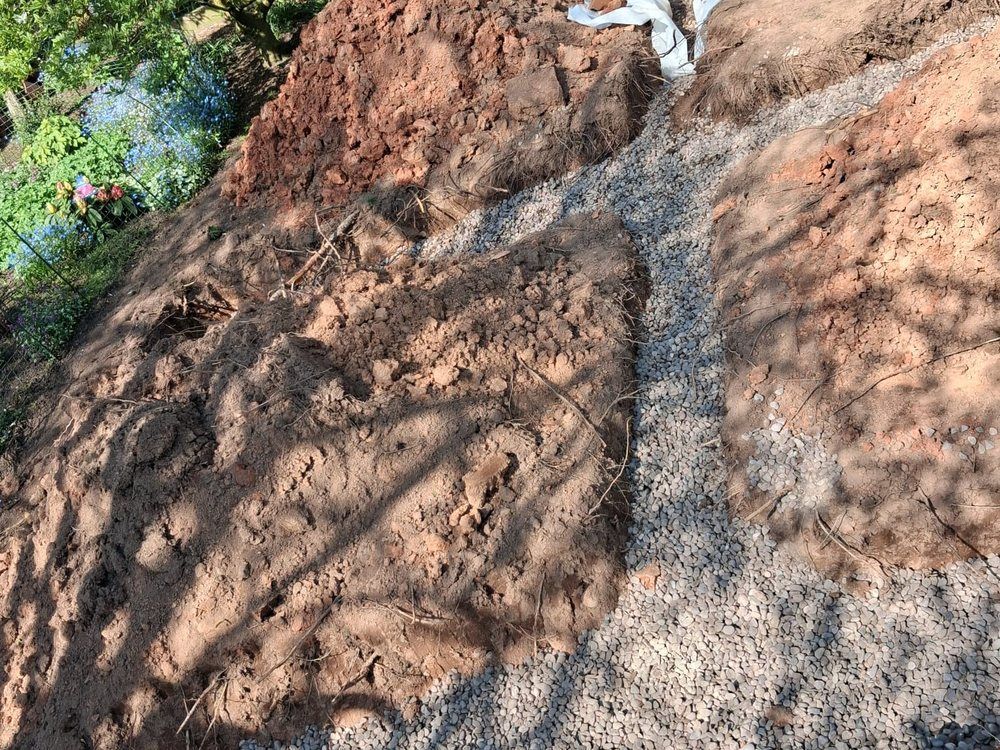
Membrane-lined trenches, washed stone and perforated pipe, laid to a fall and taken to a real outlet.
Soakaways
Crate systems sized against a percolation test and positioned to the required setbacks.
Soakaway replacement
Silted crates and old rubble pits excavated and rebuilt properly.
Branch runs into a spine, for a lawn that holds water across its whole area.
Drainage tracing
Establishing which pipe is which before anything is connected to the wrong one.
Levels and falls
Paths and patios reset so they move water away from the brickwork instead of into it.
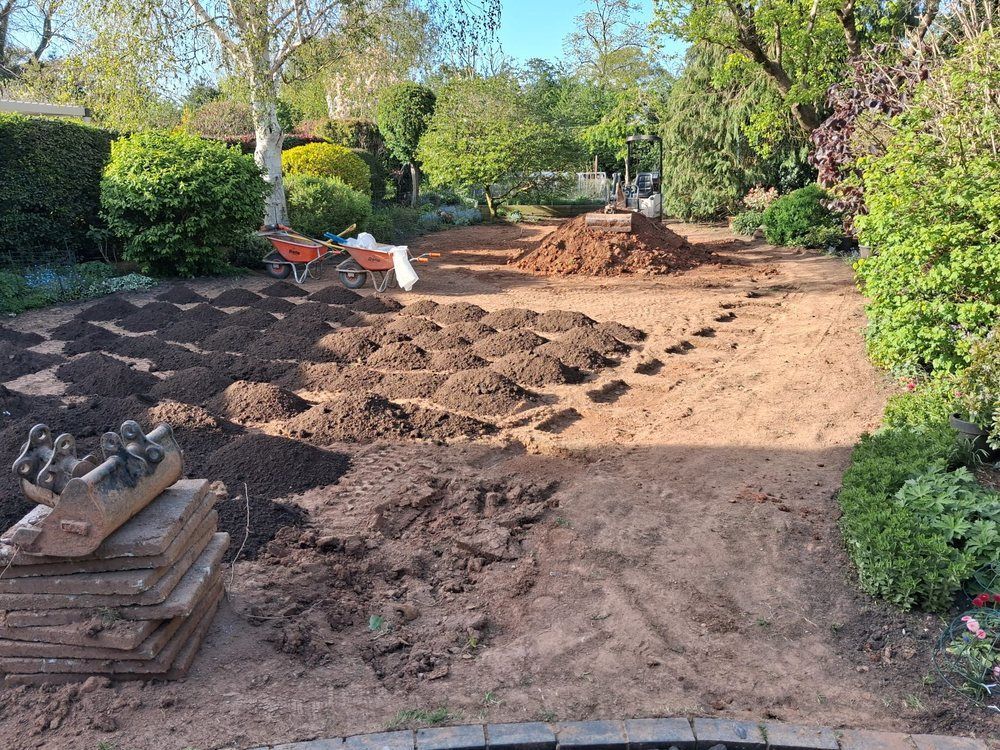
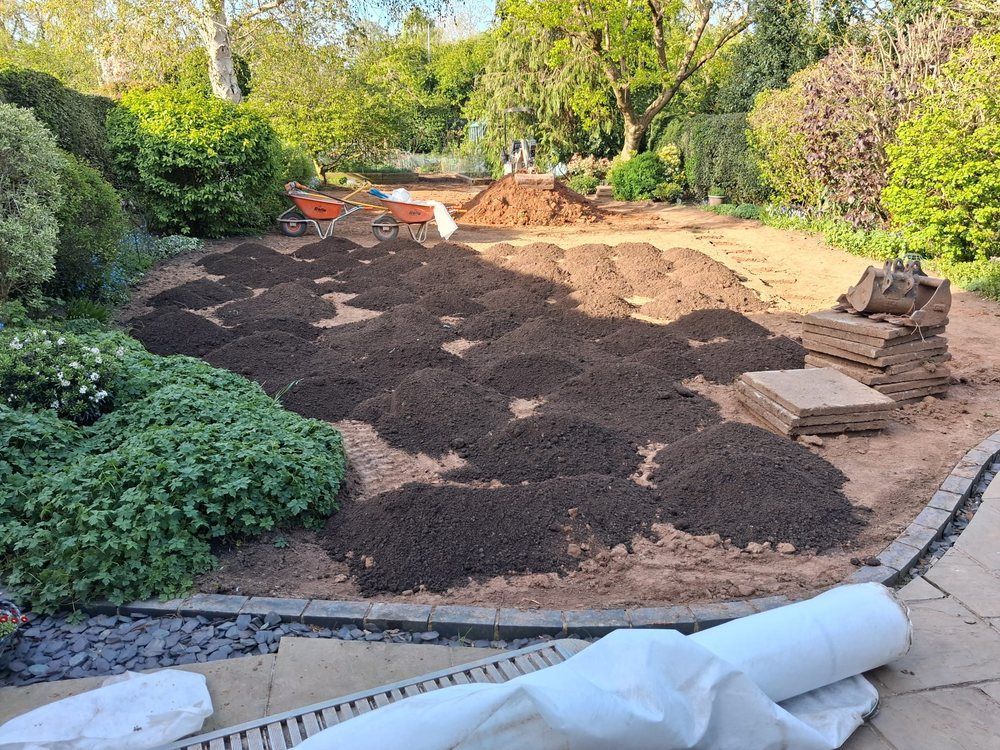
Soil, grass and borders put back so the garden looks untouched.
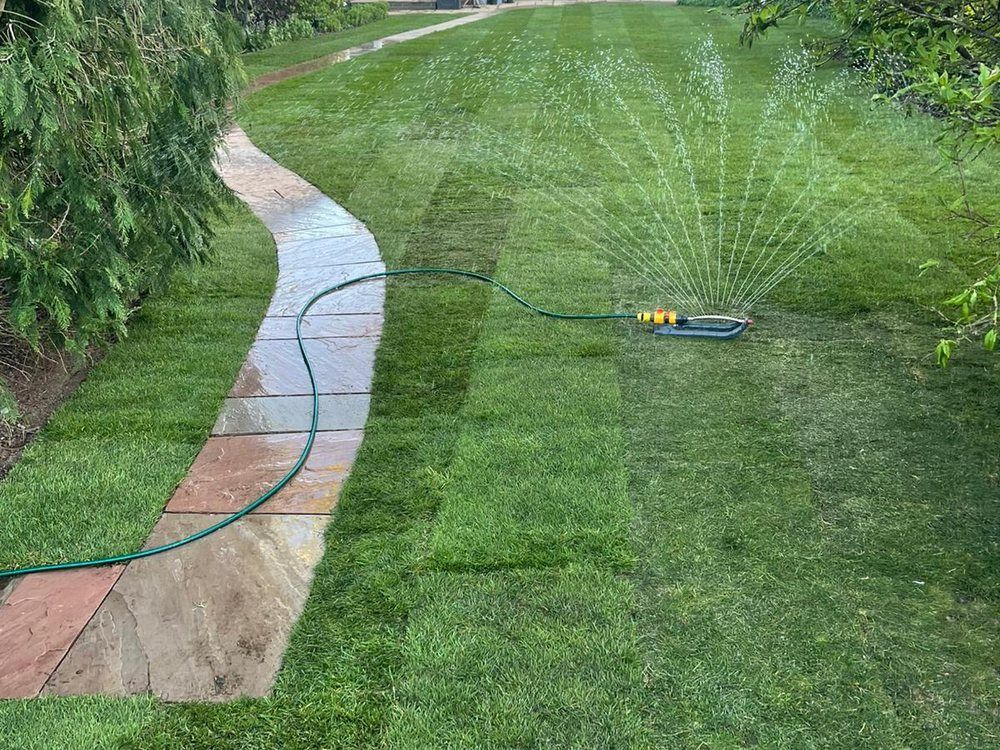
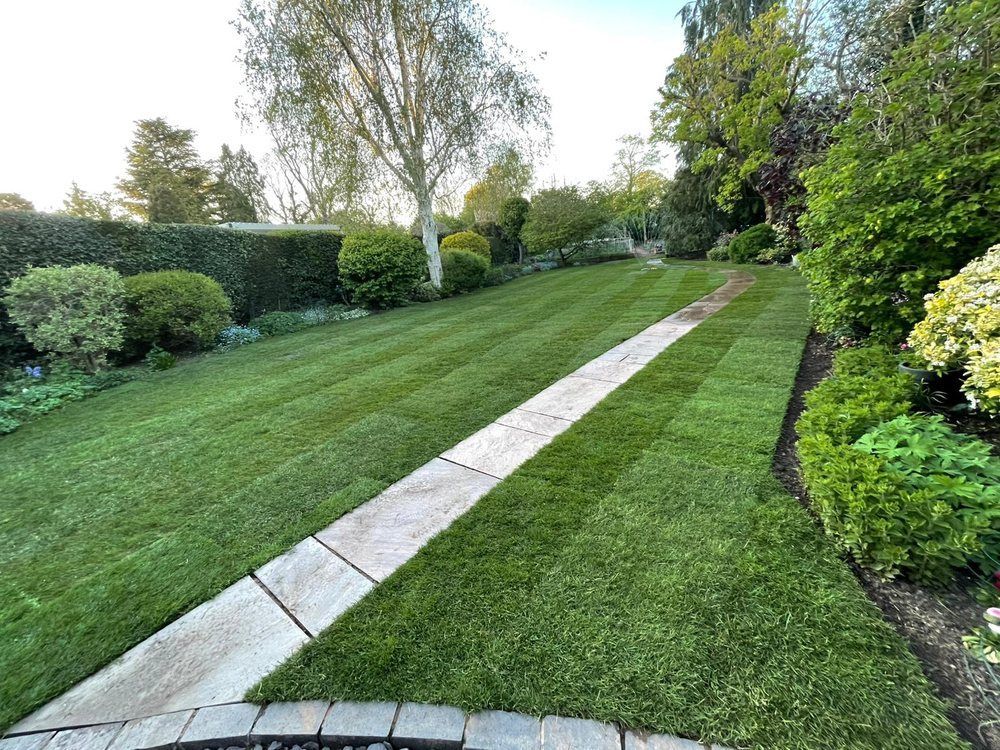
A drainage job through the build
Photographs from a recent scheme at Kenilworth. Different county, same clay, and the same sequence of work from open trench to finished lawn.
Older streets, combined drainage and a lot of roof water
Hinckley grew early and grew again, and the two halves behave differently below ground. In the older terraced and semi-detached streets near the centre, surface water and foul water frequently share a single pipe, which is how drainage was built before the two were routinely separated. On the later estates out towards Burbage and the edges of town, drainage is generally separate but the gardens sit on the same heavy clay as everywhere else in the region.
The combined-drainage streets create a particular difficulty. There may be no surface water drain available at all, which removes one of the obvious destinations for a garden scheme. It also means the gully that looks convenient may be the wrong one, and connecting garden drainage into a foul or combined pipe is both prohibited and a reliable way to turn a wet lawn into a considerably worse problem.
Meanwhile the roof carries on shedding. A modest semi sheds tens of thousands of litres in a normal year, all of it concentrated into two or three downpipes. Where those discharge is frequently the single biggest influence on whether the garden nearest the house is usable.
Where roof water is supposed to go
The general position in England
- Not into a foul sewer. Rainwater in a foul pipe overloads treatment and contributes directly to sewer flooding, and on combined systems it is the most common accidental misconnection there is.
- Infiltration is the first option. Part H of the Building Regulations expects rainwater to soak into the ground before a watercourse is considered and a sewer after that, with each option ruled out before the next.
- A downpipe discharging at a wall is not a solution. It puts a concentrated volume into the ground immediately beside the building, which is where you least want it.
- Disconnection has to go somewhere. Taking a downpipe off a drain only helps if there is a properly sized soakaway or a permitted outlet at the end of it.
- Planning goes to a different council here. Hinckley sits in Leicestershire, so anything requiring the local authority runs through Hinckley and Bosworth Borough Council rather than a Warwickshire one.
This is the general position rather than advice about a particular property; we install drainage rather than adjudicate on it. What we do at survey is establish which pipes exist and what they actually are, so nothing gets connected on an assumption.
Tracing first, digging second
On a Hinckley property of any age the survey starts with lifting covers and working out what runs where. It is unglamorous and it regularly changes the design, because the drainage people believe they have and the drainage they actually have are often different things.
From there the work is conventional: a trial hole and a timed percolation test to establish what the ground will accept; trenches cut to a consistent fall, lined with geotextile and filled with washed aggregate around perforated pipe; a soakaway sized from the test where infiltration is available; and roof water taken to the same destination where that makes sense. More detail on the methods is on our garden drainage page, and the clay soil guide explains the ground.
What changes the price
- Whether an outlet exists. In the combined-drainage streets there may be nothing usable, which means everything has to be dealt with on your own ground.
- Roof water or garden water or both. Dealing with downpipes alone is sometimes a modest job that solves most of the problem.
- Access. Terraced gardens with no rear entry mean barrow work through the house, which is slower rather than impossible.
- Spoil. Clay is heavy, it cannot be spread on the garden, and it leaves by lorry.
- Reinstatement. Turf is quick; paths, borders and edging take longer to put back properly.
The quotation after the survey covers the crew, the plant, excavation, all materials, spoil removal and reinstatement.
Why Hinckley clients call us
A lot of drainage money gets spent on the wrong half of the problem. We would rather find out which half it is first.
We lift the covers
Knowing which pipe is surface water and which is foul is the difference between a fix and an expensive mistake.
Roof water is treated as part of the job
It is frequently the largest single volume arriving in a garden, and dealing with it is sometimes most of the solution.
Built so it keeps working
Membrane, washed aggregate and a true fall. The failure mode is slow and silent, which is exactly why it gets skipped.
Established and insured
Trading since 2015, £1M public liability, and over 40 years of combined experience on the team.
Drainage in the surrounding area
Frequently asked questions
Do you cover Hinckley and Burbage?
Yes, and the villages around them, as well as over the county line into Nuneaton, Bulkington and Bedworth. The county boundary makes no difference to where we work.
How do I find out where my downpipe goes?
Sometimes by lifting the nearest cover and looking, sometimes by tracing it with dye or a camera. What you should not do is assume, particularly on an older property where surface water and foul may share a pipe. It is the first thing we check at survey and it regularly changes what we recommend.
Our street has combined drains. Does that stop us doing anything?
No, but it removes the easiest option. Garden drainage cannot be connected to a combined or foul sewer, so the water has to be dealt with on your own land, usually through a soakaway where the ground allows or by reducing and redirecting what arrives. We establish what is actually in the ground before designing around it.
Can disconnecting the downpipes really make that much difference?
Frequently, yes. A roof of average size sheds a very large volume over a year, concentrated into two or three points. If one of those is discharging beside the house or into something that no longer works, moving it to a properly sized soakaway can transform the ground nearest the building on its own.
Which council covers Hinckley for drainage matters?
Hinckley is in Leicestershire, so anything needing the local authority goes to Hinckley and Bosworth Borough Council rather than a Warwickshire one. It is worth knowing, because a lot of the guidance people find online when searching locally relates to the wrong council.
How long will the work take?
Usually somewhere between a few days and a fortnight. Access is the main factor: where a machine can reach the working area the digging is quick, and where everything moves by barrow the same job takes several times longer.
What does garden drainage cost in Hinckley?
It depends heavily on whether there is a usable outlet, which in the older streets there often is not. We survey, trace what exists, test the ground, and then give one figure covering everything through to putting the garden back.
Wet garden in Hinckley?
Tell us where the water sits and where the downpipes discharge. We will come and trace what is actually in the ground.
