
Garden Drainage and Soakaways in Binley
Drainage for estate gardens, and working out which pipes are actually yours
Binley is largely estate housing on Coventry clay, and it produces a particular sort of drainage question: not just how to move the water, but whose drain it is once it has moved. On streets where properties share below-ground runs, the answer is less obvious than most homeowners expect, and it changes who pays.
Drainage work we carry out in Binley
Perforated pipe in membrane-lined trenches of washed stone, collecting water from across the wet ground.
Branch runs feeding a spine, where the lawn holds water across its whole area.
One intercepting line where the water arrives from a single direction.
Soakaways
Sized from a percolation test and positioned to the standard setbacks from house and boundary.
Soakaway replacement
Rubble pits and silted crates dug out and rebuilt rather than supplemented.
Drainage tracing
Finding out what runs where, and which of it is your responsibility.
Levels and falls
Paving and paths reset so water is shed away from the house instead of held against it.
Screened soil, new turf and borders made good as part of the same job.
What a drainage job involves
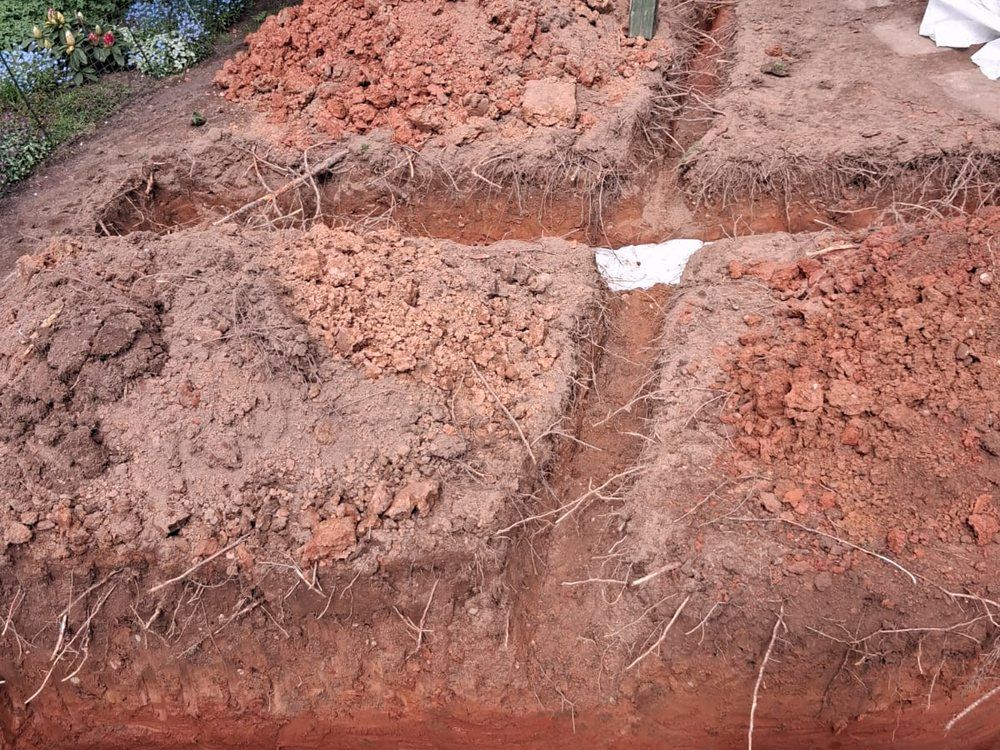
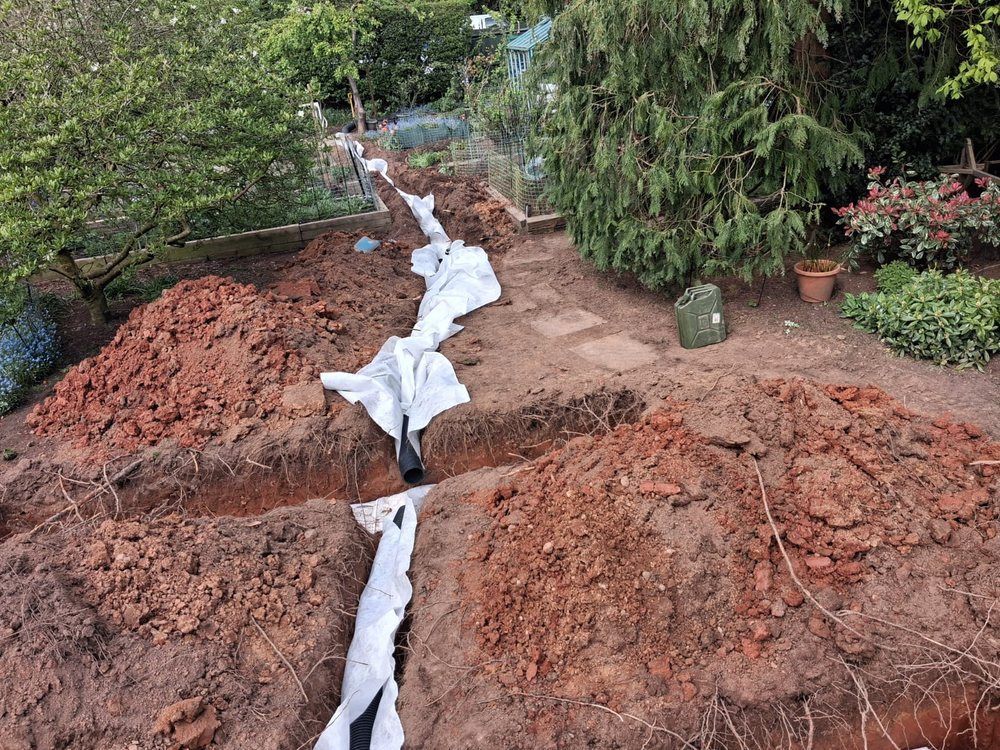
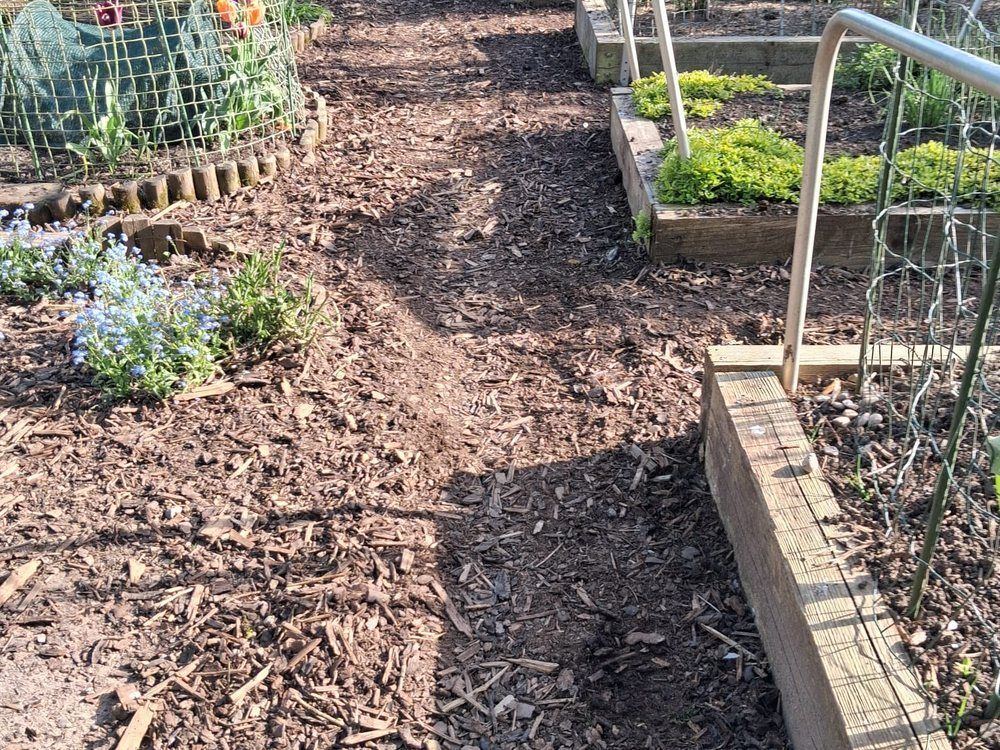
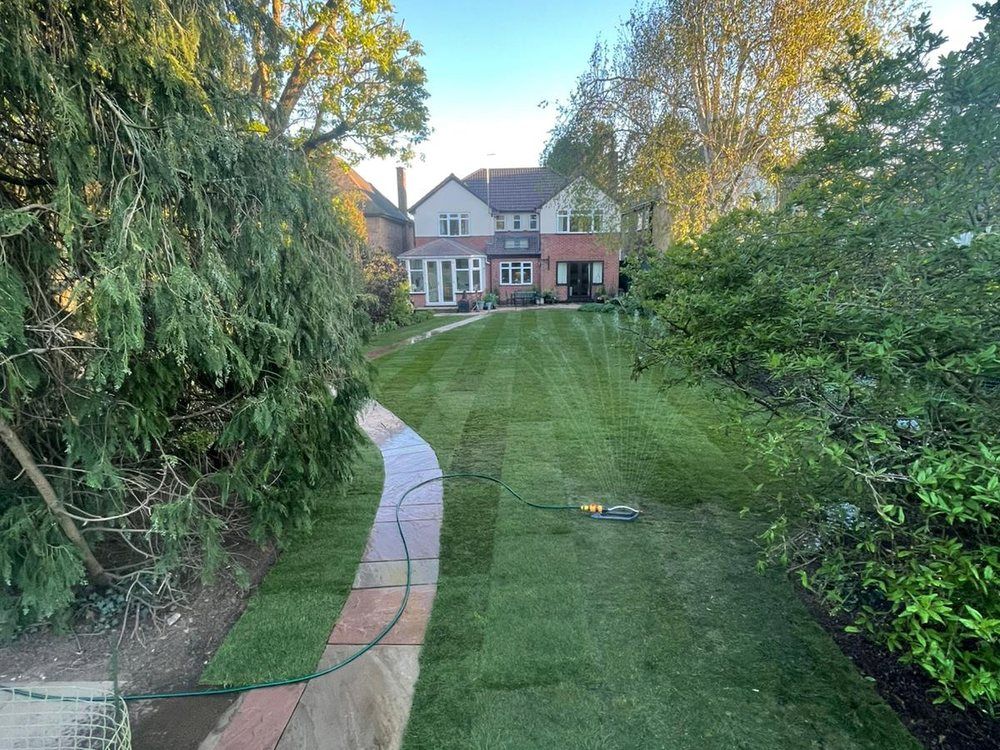
Photographs from a recent scheme at Kenilworth, showing the sequence from open ground through to a finished lawn. The clay is the same as Binley sits on.

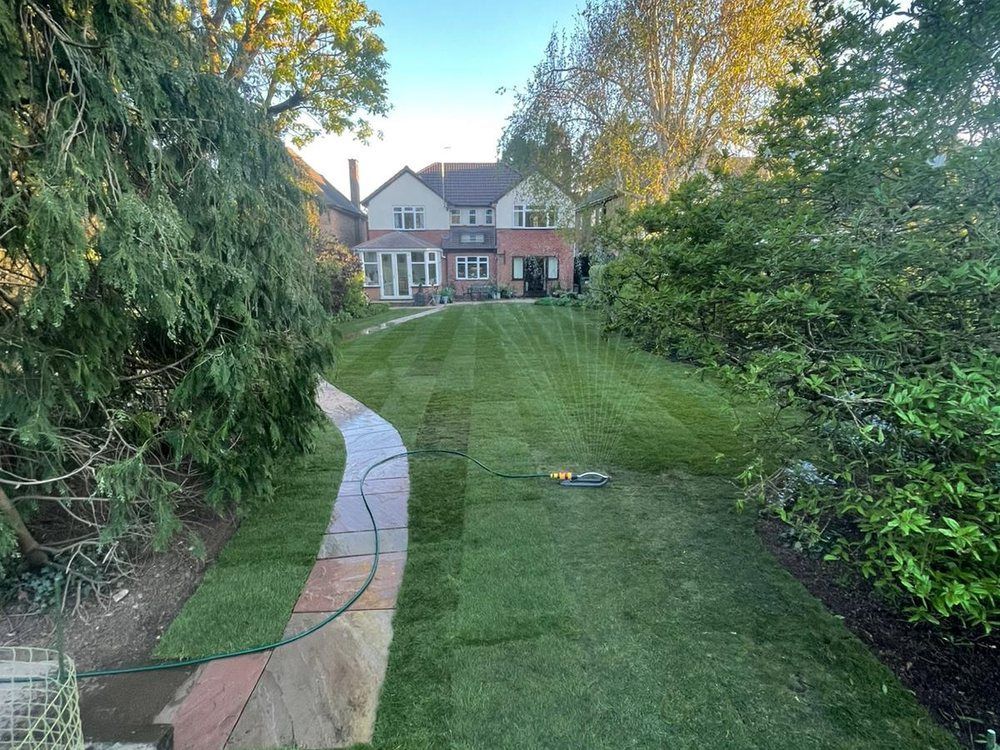
Estate gardens on Coventry clay
Most of Binley was built as estate housing, and the gardens share a pattern: rectangular plots, thin topsoil over compacted clay subsoil, and boundaries of fence rather than wall. It drains badly for the ordinary reasons and it drains badly consistently, which is why whole runs of gardens on the same street often have the same complaint.
Two features are worth naming. Levels frequently run across the plots rather than along them, so water moves sideways between gardens rather than down the length of one, and a scheme that only drains the middle of your lawn will be fed by everything arriving from next door. And below-ground drainage on estates is often shared, with several houses connecting into a common run before it reaches the public system.
That second point is the one that surprises people, because it determines who is responsible for what.
Which drains are yours and which are not
Since 2011 this has been considerably clearer than it used to be, and it is worth understanding before you pay to fix something that is not your responsibility.
The general position in England and Wales
- Shared drains transferred to the water company. In October 2011 most private sewers and lateral drains that served more than one property and connected to the public network became the responsibility of the sewerage undertaker, which here is Severn Trent.
- What remains yours is the drain serving only your property, within your own boundary. That is the part a homeowner still maintains.
- Blockages on a shared run are generally reportable rather than something to pay a private contractor for, and it is worth a phone call before it is worth a quotation.
- None of this makes a shared drain available for garden drainage. A transferred sewer is still a sewer, and land drainage does not go into it. Connecting to anything public is an application under Section 106 of the Water Industry Act 1991.
We install drainage; we are not the water company and this is the general position rather than advice about your property. Where something looks like it may be a reportable problem rather than a job for us, we will say so at survey.
Designing for a garden that receives water from elsewhere
Where levels bring water across from adjoining plots, a scheme confined to the middle of the lawn will be permanently fed and will always look marginal. The answer is to intercept at the boundary — a run along the high side of the garden catching water before it spreads — and then deal with what the garden itself produces separately.
That requires knowing the levels rather than guessing them, which is part of the survey. From there it is conventional construction: trenches to a consistent fall, geotextile between soil and stone, washed aggregate around perforated pipe, and a destination that can take the volume. A soakaway where the percolation test supports one; collection and routing where it does not.
Because we are landscapers, reinstatement is part of the contract. Our drainage service page covers the methods, and the clay soil guide explains what the ground is doing.
What the price turns on
- Whether interception is needed. A boundary run to catch water arriving from next door is extra length, and on a cross-falling plot it is what makes the scheme work.
- The destination. A tested soakaway on your own ground, where the clay allows one, or collection and routing where it does not.
- Access. A side gate a machine can get through changes the labour completely.
- Spoil. Every cubic metre of clay excavated leaves by lorry.
- Reinstatement. Turf, borders, paths and edging returned to how they were.
Once surveyed, one figure covers the crew, the machine, the digging, all materials, spoil removal and putting the garden back.
Why people in Binley use us
Estate gardens look simple and frequently are not, because the water arriving in them started somewhere else.
We check whose problem it is
If something is a reportable blockage on a transferred sewer, that is a phone call rather than an invoice, and we will tell you.
Levels before layout
On a cross-falling plot, where the interception run goes matters more than how much pipe there is.
Built to keep working
Geotextile, washed stone and a true fall on every run, because a silted system fails quietly.
Local since 2015
Coventry is our home city, and Binley is one of the areas we work in most, with £1M public liability cover.
Drainage in nearby areas
Frequently asked questions
Do you cover Binley and the rest of east Coventry?
Yes. Coventry is our home city and Binley is one of the areas we work in most, along with Wyken, Stoke, Willenhall and out towards Ryton-on-Dunsmore and Brandon.
Water comes into my garden from next door. Can that be drained?
Yes, by intercepting it at the boundary rather than trying to drain the middle of the lawn. A run along the high side of the plot catches water before it spreads, and the garden’s own water is dealt with separately. It needs the levels established properly, which is part of the survey.
Who is responsible for the shared drain behind our houses?
Most likely the water company. In 2011 private sewers and lateral drains serving more than one property and connecting to the public network transferred to the sewerage undertaker, which here is Severn Trent. What remains a homeowner’s responsibility is the drain within their own boundary serving only their property. If a shared run is blocked, it is worth reporting before paying anyone.
Can garden drainage connect into the shared drain?
No. A transferred sewer is still a sewer, and land drainage does not go into foul or combined pipes. Connecting to anything public runs through an application under Section 106 of the Water Industry Act 1991, and in most estate gardens the practical answer is to deal with the water on your own land instead.
The whole street has the same problem. Is it worth doing just my garden?
Usually yes, provided the scheme is designed for the situation rather than dropped in. A garden that receives water from higher ground needs interception at the boundary; without that, any system will be permanently loaded and will look like it is not working. With it, a single plot can be fixed on its own.
How much disruption is there?
The garden looks like a building site for a few days while the trenches are open, and then it does not. Topsoil goes back, turf or seed is laid, and borders and paths are reinstated. Within a season there is nothing to see.
What does garden drainage cost in Binley?
It depends on whether a boundary interception run is needed and where the water can be sent. We survey, check the levels, test the ground and then give one figure covering everything through to reinstatement.
Estate garden in Binley holding water?
Tell us where the water arrives from and where it sits. We will check the levels and the drains before proposing anything.
