
Garden Drainage and Soakaways in Nuneaton
Land drainage and soakaways for clay, made ground and gardens with no obvious outlet
Nuneaton gardens rarely give you what you expect a spade’s depth down. Between the old coalfield, decades of quarrying and generations of estate building, the subsoil under a lawn here can be clay, compacted fill, or a layer of somebody else’s rubble. That is exactly why we open the ground and look before we price a drainage scheme.
Drainage work we carry out in Nuneaton
Membrane-lined trenches, clean stone and perforated pipe, cut to a fall and taken to a proper outlet.
For lawns that are wet across the whole area. Branch runs collect the water, a main run carries it off.
A single line to catch water coming from one place — a bank, a boundary, a neighbouring hard surface.
Soakaways
Built where the ground will genuinely take water, at the proper distances, and sized against a percolation test.
Soakaway replacement
Old pits packed with brick rubble and crates that have silted solid, dug out and replaced with something that works.
Drainage in made ground
Where fill, hardcore or old foundations turn up mid-trench, the design changes. Better to find that out at survey.
Levels and falls
Resetting paths and patios that currently run water back towards the house rather than away from it.
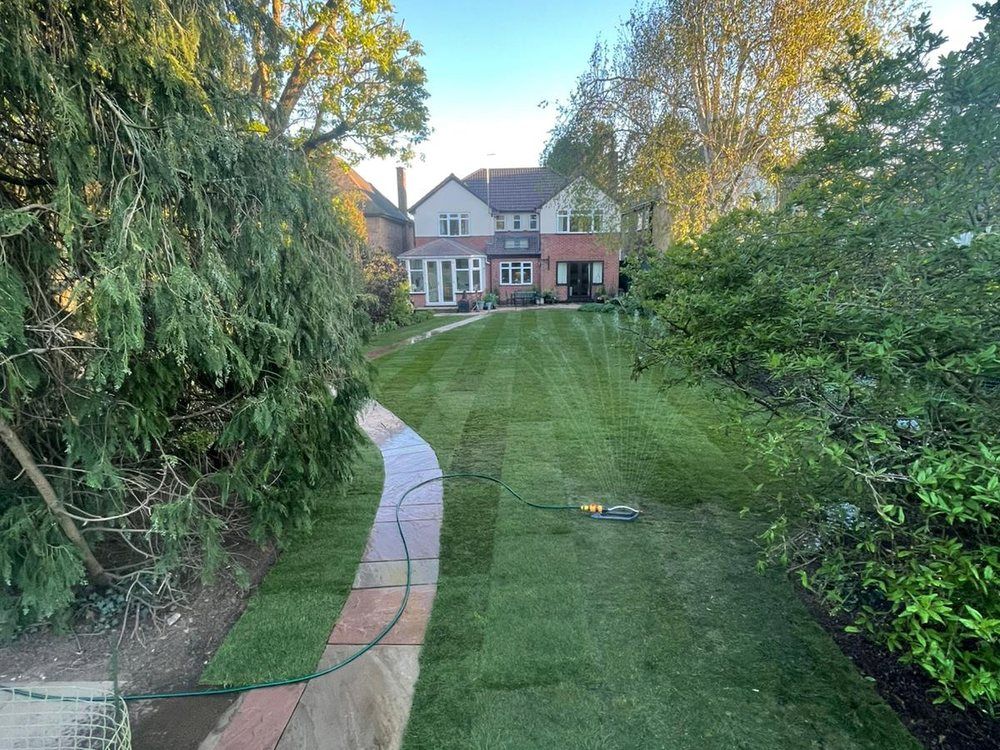
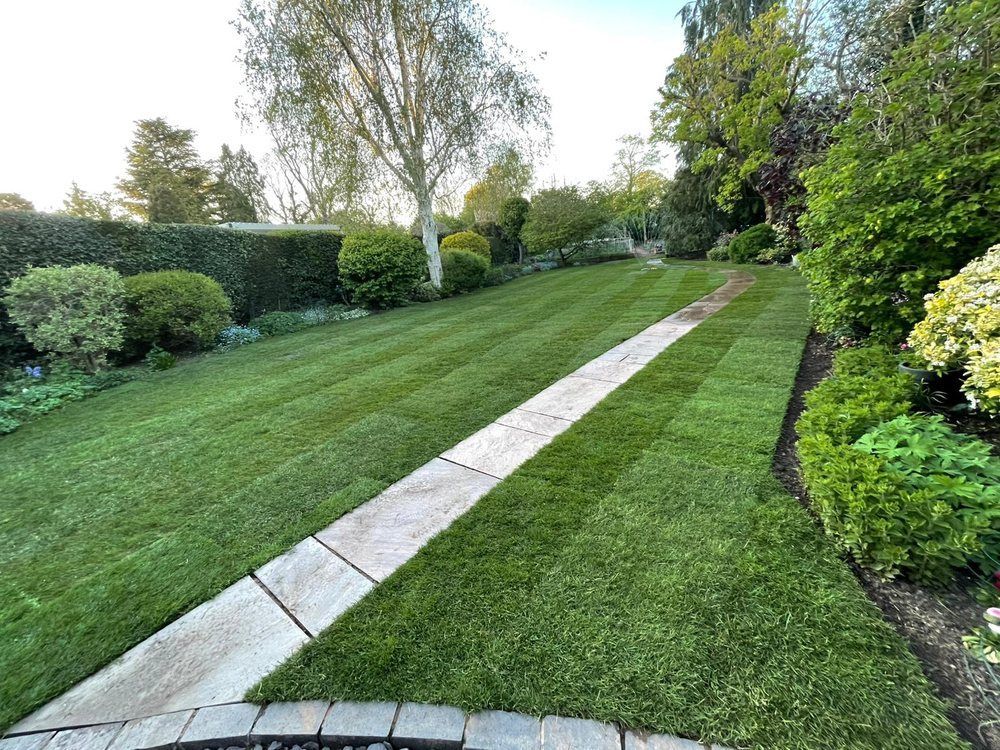
Screened soil, fresh turf or seed and the borders made good, so nothing about the garden says it was recently dug.
A drainage job, start to finish
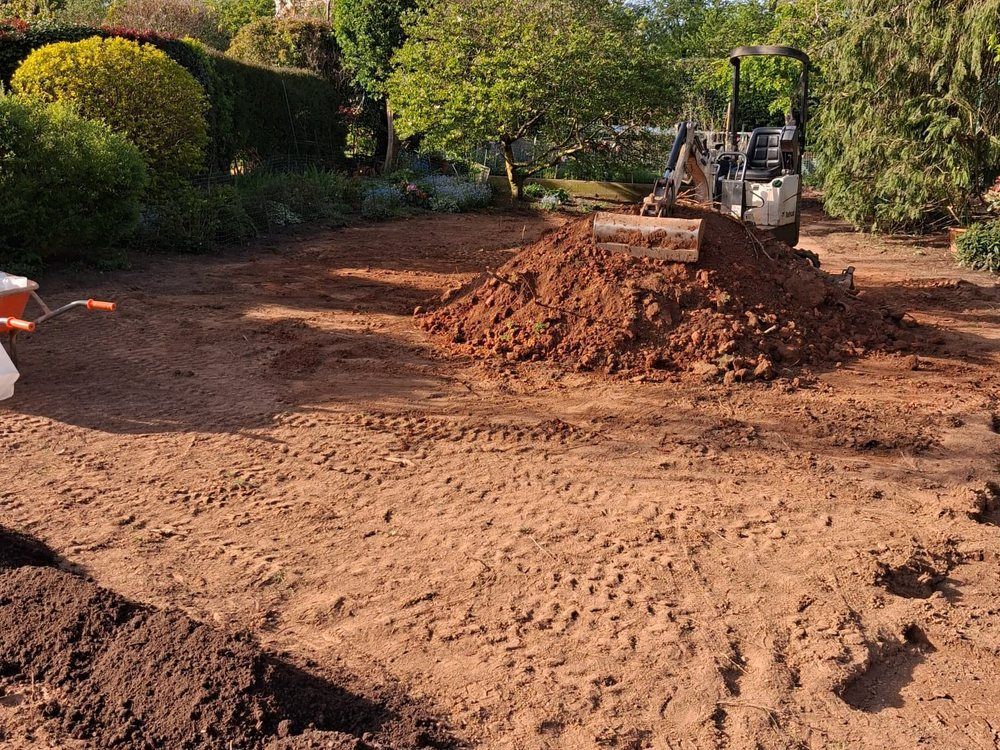
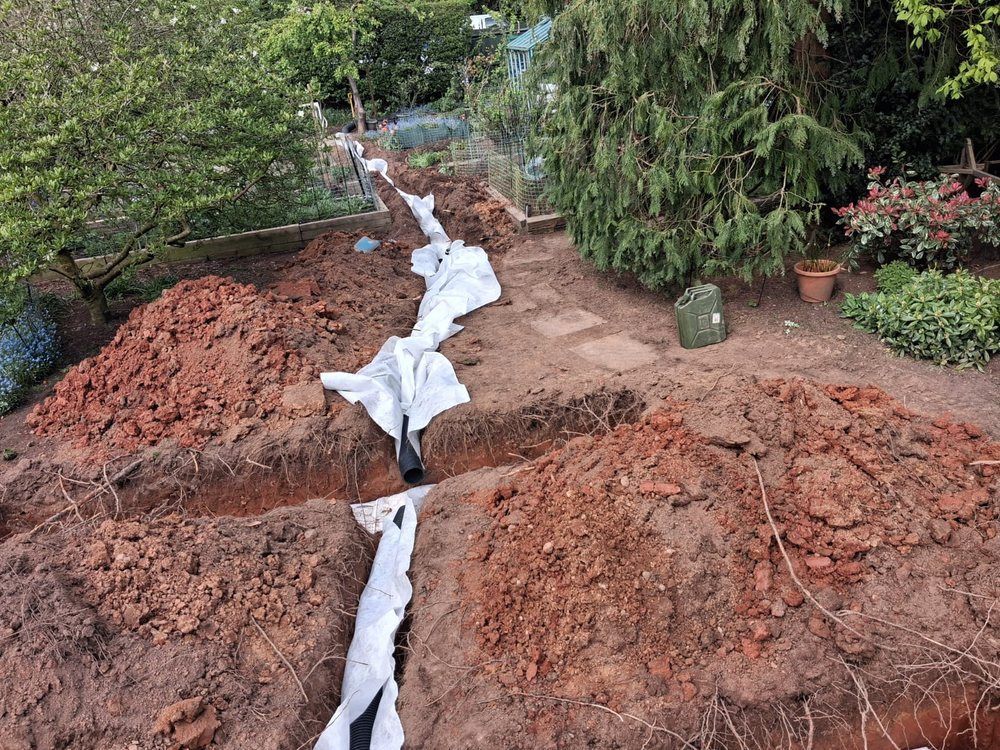
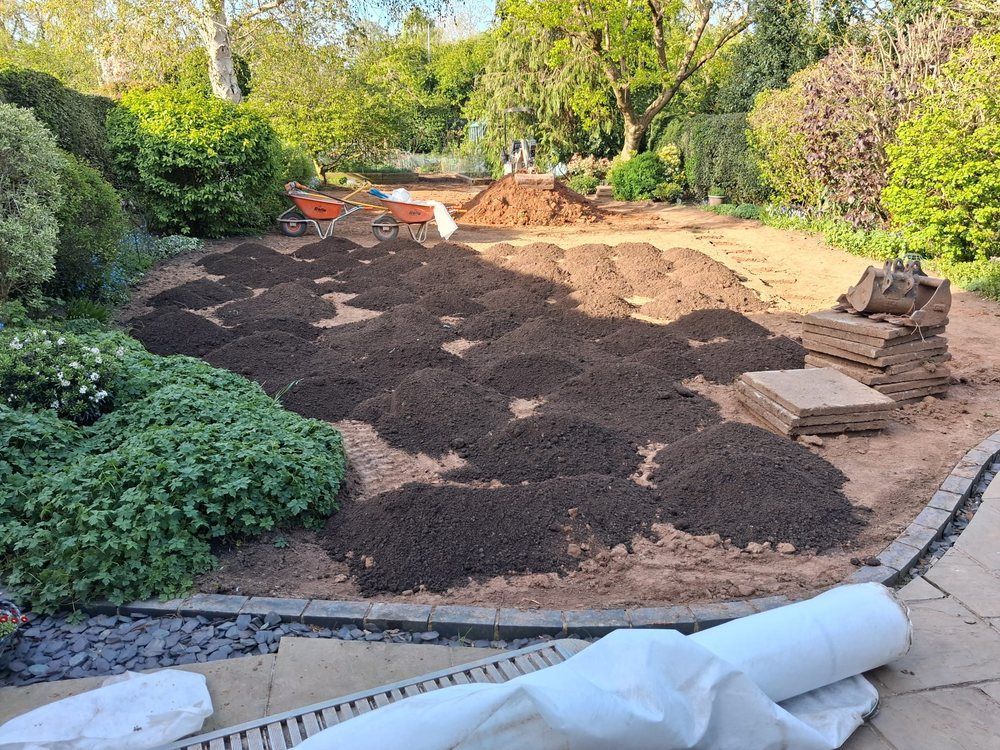
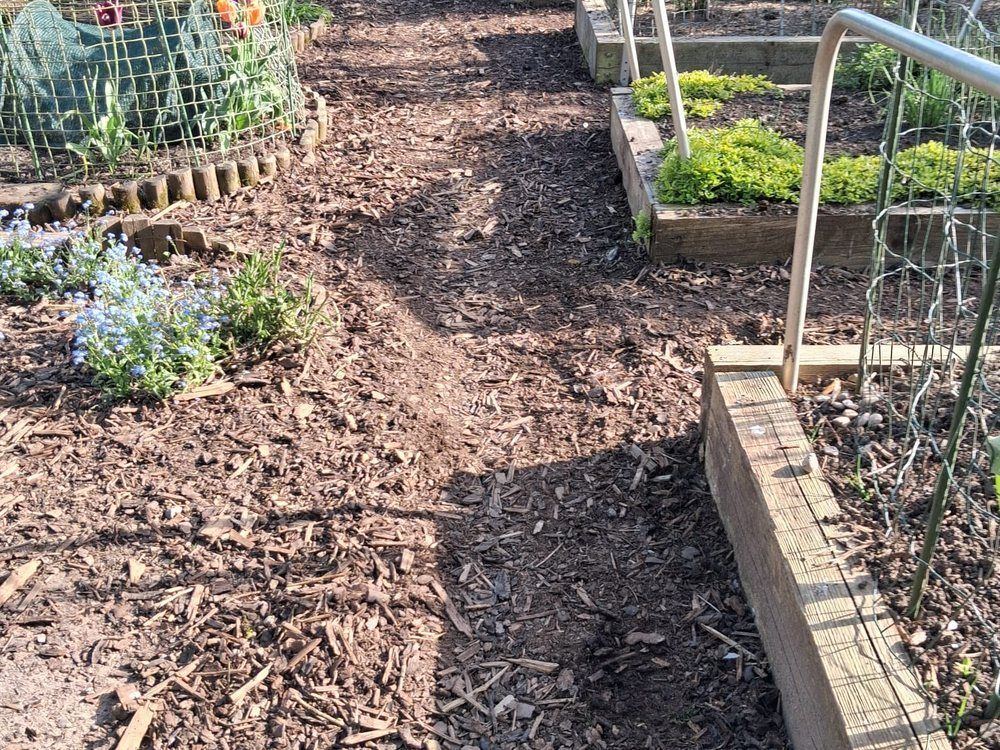
These photographs are from a recent scheme at Kenilworth. The ground is the same red Warwickshire clay we dig in Nuneaton, and so is the method.
What is actually under a Nuneaton lawn
Most of the town sits on heavy clay, which is reason enough for a garden to hold water. What makes Nuneaton less predictable than its neighbours is everything that has been done to the ground since. This was coalfield and quarrying country, and the housing that followed was built quickly and in volume. Made ground is common — imported fill, crushed hardcore, buried foundations, the odd forgotten path a foot under the turf.
The practical consequence is that a drainage design drawn from the surface is a guess. A trench that was going to be a straightforward run at 700mm meets a slab of concrete, or opens into loose fill that will not hold a trench wall. Neither is a disaster if you know before you start. Both are expensive surprises if you do not.
The estate layouts matter too. Long, narrow gardens at Stockingford, Attleborough, Whitestone and Weddington often have no side access at all, which changes how the work is done more than what the work is.
How the job is built
Every scheme starts with a trial hole and a timed drainage test. On made ground we usually dig more than one, because what is under the top of the garden may be nothing like what is under the bottom.
The trench
Cut to a consistent fall, lined with geotextile, part-filled with clean aggregate, perforated pipe laid and covered over. The membrane is what stops fine clay particles washing into the stone and choking the voids, and leaving it out is the most common reason a system that worked for two winters stops working in the third.
The outlet
A drainage run is only as good as the place it discharges to. That might be a soakaway where the ground will take it, an existing surface water drain, or a watercourse with the right consent. In made ground a soakaway needs particular care: loose fill can accept water quickly at first and then behave very differently once it settles.
Putting it back
Topsoil returns over the system, turf or seed goes down, and paths, beds and edging are reinstated. We are landscapers, so this is part of the job rather than something you arrange separately afterwards.
Where your water ends up is your responsibility
On estate gardens that back onto each other, this is the question that causes the most trouble, and it is rarely asked until somebody is annoyed.
The general position in England
- You cannot drain onto a neighbour’s land. Deliberately discharging collected water onto adjoining property can amount to a private nuisance, and a system that fixes your lawn by flooding the garden behind you is a dispute rather than a solution.
- Water that arrives naturally is treated differently from water you channel. Ground that has always shed water downhill is one thing. Gathering it into a pipe and delivering it over a boundary is another, and the law looks at them differently.
- Garden and land drainage has no business in a foul sewer. Rainwater sent down a foul pipe overloads the treatment works and pushes sewers towards flooding. Where a public surface water sewer is the right destination, Severn Trent handle the application, made under Section 106 of the Water Industry Act 1991.
- Soakaways cannot go just anywhere. Guidance puts them no closer than about five metres to a building and roughly two and a half metres off a boundary, with capacity calculated from a BRE Digest 365 percolation test.
That is the broad legal backdrop and not a view on your boundary, which is solicitor territory rather than ours. What we will do is design a scheme that disposes of your water within your own land wherever that is achievable, and tell you plainly at survey stage when it is not. Our garden drainage service page covers the methods, and the clay soil guide explains the ground.
What the price depends on
The ground dictates the price, so nothing is quoted until it has been opened. What shifts the number:
- What is down there. Clay is predictable. Fill, hardcore and buried concrete are not, and they take longer to dig through and more lorries to take away.
- Length of run. A single intercepting line along a fence is a very different job from a full herringbone.
- Access. A garden a small machine can reach costs a fraction of one where every barrow goes through the house.
- The outlet. An existing drain in a sensible place is cheap. A soakaway that has to be tested, dug and sized is not.
- Reinstatement. Turf is fast. Mature borders, paths and edging take time to put back properly.
One quotation after the survey, covering labour, plant hire, digging, materials, every lorry load removed and the garden reinstated.
Why people choose us for drainage in Nuneaton
On ground this unpredictable, the difference between a good drainage job and a bad one is almost entirely in what happens before the digging starts.
We dig trial holes, often more than one
On made ground the top of the garden tells you nothing about the bottom. We find out before we commit you to a design.
No surprises mid-job
If something turns up that changes the scheme, you hear about it the same day with a revised position, not in a bill at the end.
Built to still work in ten years
Membrane, clean aggregate and a true fall. Skip any one of the three and the system silts up quietly.
Local, insured and ten years in
Working across Nuneaton and Warwickshire since 2015, with £1M public liability cover.
Towns and villages we also cover
Frequently asked questions
Do you cover Nuneaton, Bedworth and Bulkington?
Yes. We work across Nuneaton and the surrounding area, including Bedworth, Bulkington, Galley Common, Attleborough and Weddington, and over the border into Hinckley and Burbage. Sorting out ground that holds water is a steady part of what we do in this area.
My neighbour’s garden drains onto mine. What can I do?
It depends entirely on whether the water arrives naturally because of the lie of the land, or whether it has been collected and channelled there. The first is generally something you have to manage on your own side. The second may be a nuisance. We can design a scheme that intercepts water at your boundary and takes it away, which solves the practical problem regardless of who is at fault, but the legal question is one for a solicitor rather than for us.
Will your system just push the water onto someone else?
No. A drainage scheme has to dispose of water within your own land or to a legitimate outlet, and discharging collected water over a boundary is not one. Where there is genuinely nowhere on the plot for it to go, we will say so at survey and set out what the alternatives cost rather than quietly piping it next door.
What happens if you hit concrete or rubble in the trench?
It happens regularly here. If it is a small obstruction we work around or through it. If it changes the scheme, we stop, tell you the same day, and give you a revised position before carrying on. Digging trial holes first is precisely so that this is rare rather than routine.
The garden has no side access. Can you still get plant in?
Often not, and on those jobs the work is done by hand with the spoil barrowed through the house on protected boards, or occasionally with a machine craned or carried in. It is slower rather than impossible, and we say which it will be at survey so the price is not a surprise.
How deep do the trenches go, and how much mess is there?
Typically somewhere between half a metre and a metre, depending on the fall available. The garden looks alarming for a few days because the trenches cross the lawn, and then it looks like nothing happened. The sequence higher up this page shows one garden at each of those stages.
What does garden drainage cost in Nuneaton?
We will not quote before seeing the ground, because here more than anywhere the honest answer depends on what is under the turf. After the survey the figure covers the crew, the machine, excavation, all materials, spoil removal and full reinstatement, and it is the figure you pay.
Waterlogged garden in Nuneaton?
Tell us where the water sits and how long it stays. We will come and open the ground before anyone talks about money.
