
Garden Drainage and Soakaways in Leamington Spa
Drainage for long walled town gardens, and for the ones where a soakaway will not fit
A Leamington town garden gives you very little room to solve a drainage problem. The plot is long and narrow, the walls are old and close, there is usually no access except through the house, and the distances a soakaway is supposed to keep from buildings and boundaries can use up the entire width. There is almost always an answer. It is rarely the obvious one.
Drainage work we carry out in Leamington Spa
Membrane-lined trenches with clean stone and perforated pipe, laid to a fall that survives the ground settling.
The usual answer in a narrow garden: one intercepting run down the length, taking water off before it spreads.
For the wider plots south of the river where a whole lawn holds water rather than one strip of it.
Soakaways
Sized from a percolation test and set at the proper distances, where the garden has room for one.
Soakaway replacement
Victorian rubble pits and modern crates that have silted up, dug out and rebuilt with a geotextile wrap.
Water away from walls
Getting surface water off old brickwork and away from the base of the house, which is our part of a damp problem.
Levels and permeable surfaces
Resetting falls and choosing surfaces that let water through rather than sending more of it somewhere it cannot go.
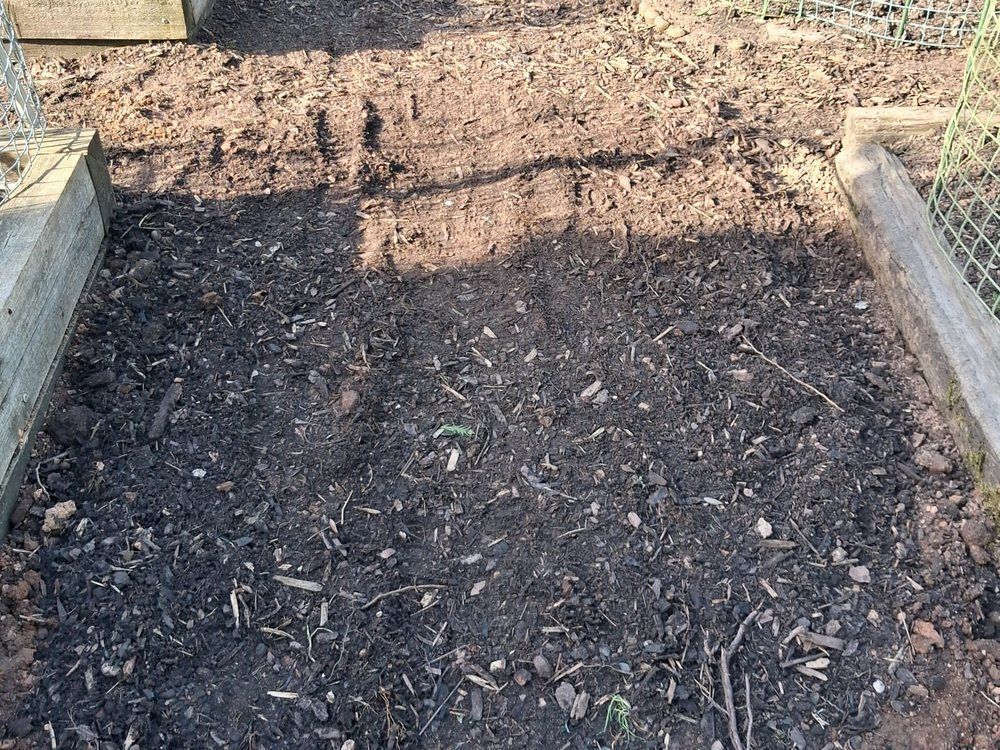
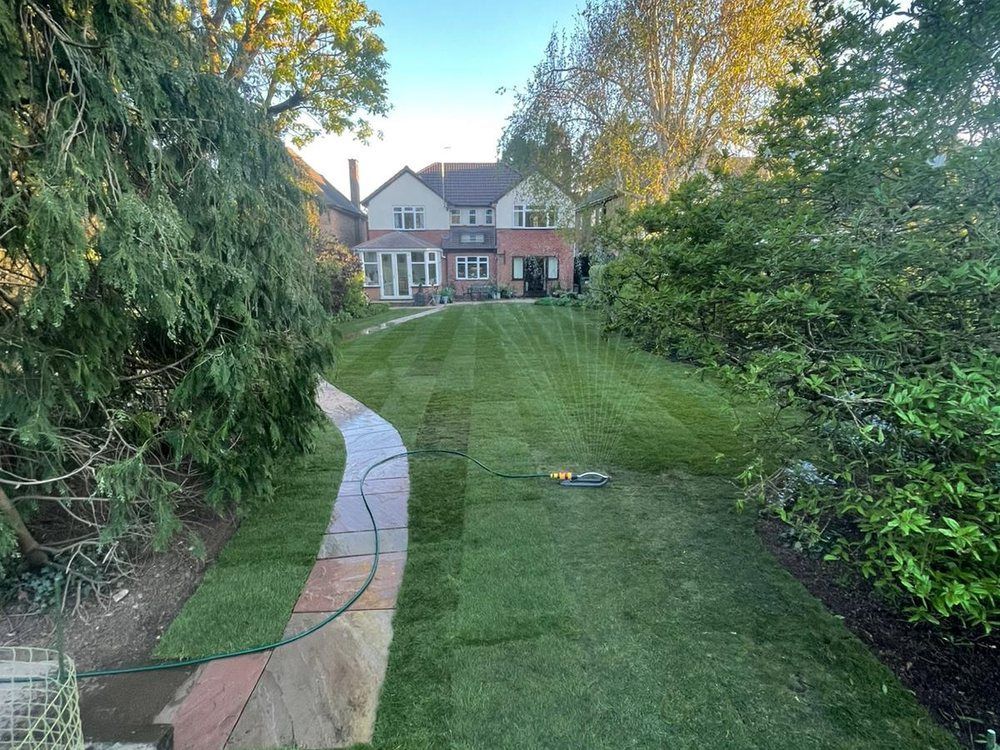
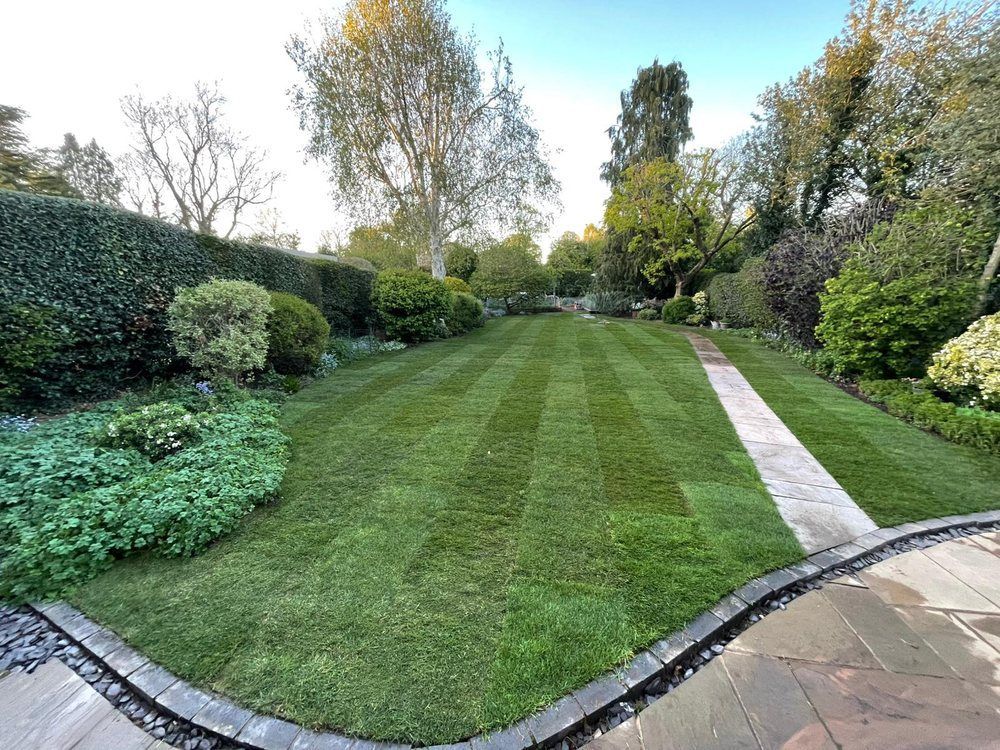
Topsoil, turf, planting and paving put back, with everything carried out the way it came in.
How a drainage scheme is built
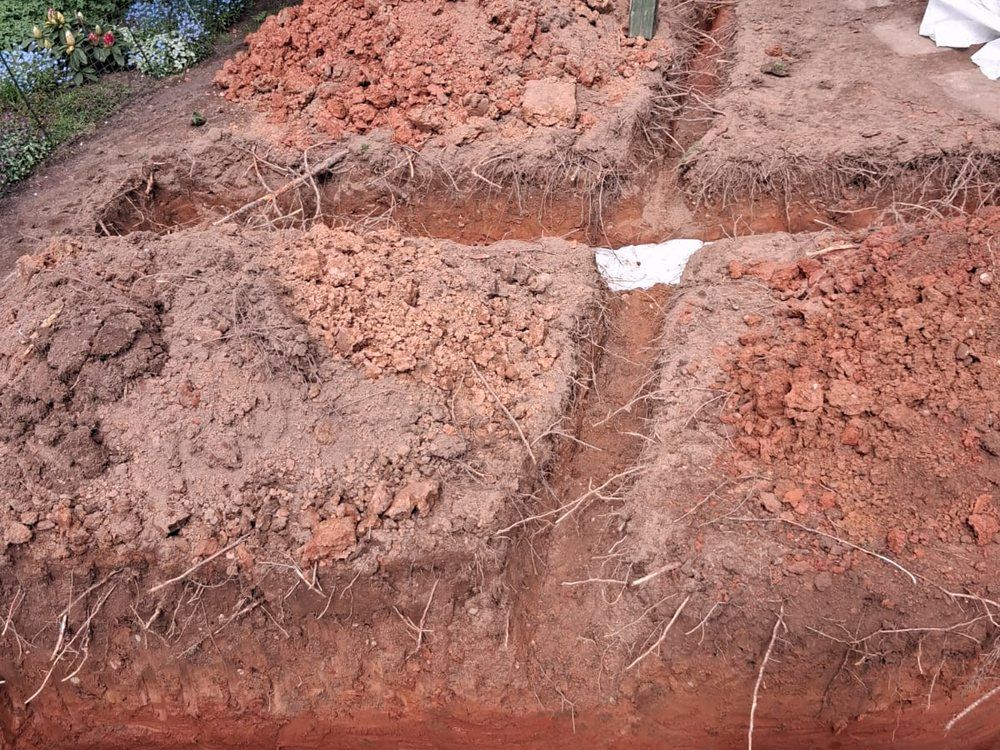
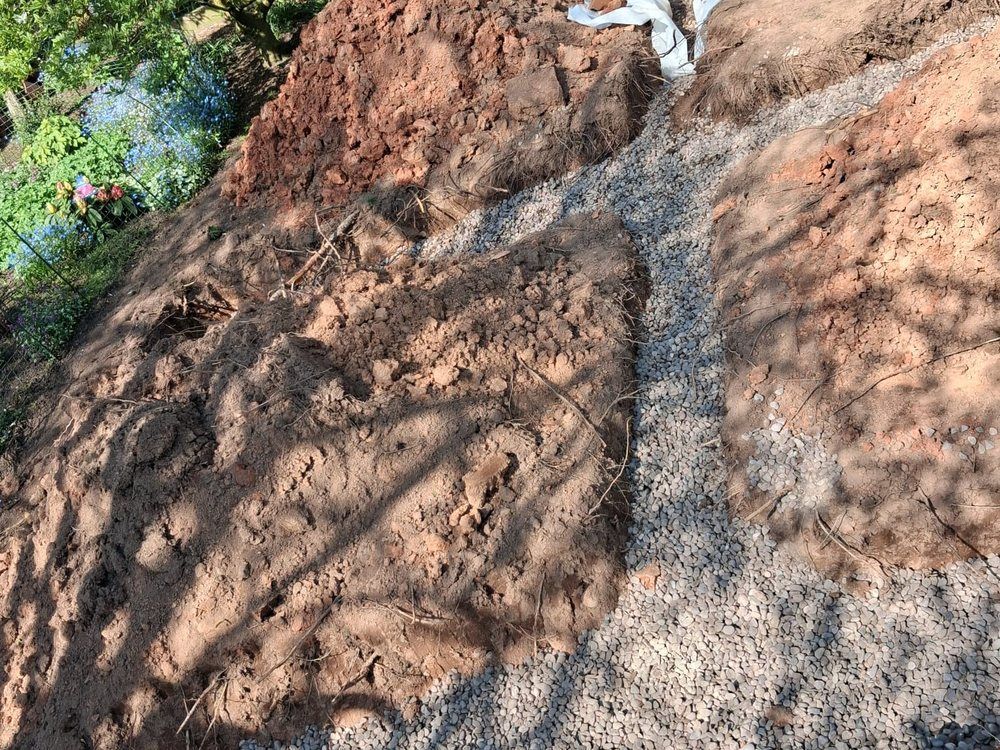
Photographs from a recent job at Kenilworth. The garden is larger than most Leamington town plots, but the trench, the membrane and the crate are exactly what goes into a smaller one.

Why Leamington gardens are a harder problem than they look
The Regency and Victorian streets north and south of the Parade share a shape: a long, narrow plot enclosed by old brick walls, with the house at one end and no way in except through it. Add the clay that runs under most of the town and you have a garden that collects water and has nowhere to put it.
Two features make it worse. Many of these houses have cellars or lightwells, so water held against the back of the building has somewhere to go that you would rather it did not. And the original drainage is often Victorian clayware, laid in short lengths with mortar joints, long since cracked by roots or settlement and doing very little except occasionally leaking into the ground where you least want it.
South of the river, at Sydenham, Whitnash and the newer estates, the plots are wider and the problem reverts to the straightforward one: compacted clay under a thin layer of topsoil, and a lawn that sits wet from November to April.
When a soakaway will not physically fit
The siting rules read simply enough on paper: roughly five metres of clearance to any building, about two and a half metres to a boundary, and a capacity calculated from a BRE Digest 365 percolation test.
Now apply that to a town garden six metres wide. Two and a half metres from each side wall leaves a strip about a metre across, and five metres from the house rules out the end of the garden nearest the problem. On a good many Leamington plots a compliant soakaway simply will not fit, and any quote that includes one without measuring first has not thought about it.
What works instead, depending on the garden:
- An intercepting run taken to the far end, where the setbacks can sometimes be met even when they cannot be nearer the house.
- Connection to an existing surface water drain, where one exists in a useful position and the connection is permitted.
- Reducing what arrives in the first place, using permeable surfacing and resetting falls so hard areas are not shedding into the one soft corner.
- Attenuation — holding water back and releasing it slowly — where the outlet exists but cannot take a downpour all at once.
Which outlet you are permitted to use
The general position in England
- The options are ranked. Under Part H, infiltration into the ground is the first choice, a watercourse the second and a sewer the last, and you are expected to demonstrate why each option was rejected before moving on. A plot with no room for a compliant soakaway is a perfectly good reason to move down that list.
- Nothing from the garden goes into a foul drain. On older Leamington properties the below-ground system is often combined and rarely recorded anywhere, so the convenient-looking gully by the back door may be exactly the one to avoid.
- Joining a public sewer is an application, not a decision. Section 106 of the Water Industry Act 1991 sets out the route, and Severn Trent are the undertaker who deal with it.
- An outfall to a watercourse needs its own consent from Warwickshire County Council as lead local flood authority, under Section 23 of the Land Drainage Act 1991, and it cannot be obtained after the work is done.
Treat all of that as background rather than a ruling on your garden — we lay pipe, we do not practise law. Anything needing a consent gets flagged and priced at survey. There is more detail on the methods on our garden drainage service page, and the clay soil guide sets out what this ground actually does with water.
What drives the figure in a town garden
- Access, before anything else. Everything in and everything out goes through the house on boarded and sheeted routes. That is the single biggest cost on a central Leamington job.
- Spoil. Clay is heavy and cannot stay on site. In a garden with no side gate it leaves a barrow at a time.
- The outlet. An existing drain in the right place is the cheap answer. Anything else costs more, and is worth the difference.
- Protecting what is there. Old walls, established planting and stone paving need care rather than speed, and care takes hours.
- Reinstatement. Putting a town garden back so it looks untouched takes longer than turfing a lawn.
Everything sits inside one quoted figure once the garden has been seen: people, digging, materials, muck away, making good, and the coordination of any specialist trade we bring with us.
Why clients pick us for a Leamington garden
In a garden this constrained, the risk is not whether the drainage works on the day. It is what the work does to everything around it while it goes in.
We measure before we promise
Setbacks, levels and percolation rates decide what is possible here. We establish all three before quoting.
Careful with the route in
Protected floors, sheeted walls, timed deliveries and nothing left on the street overnight. Your neighbours should barely notice.
Old walls and planting respected
Excavating beside a Regency garden wall is done by hand and slowly, because the alternative is a rebuild you did not budget for.
One team, one price
Agreed after the survey and covering plant, materials, construction, spoil removal and putting the garden back.
Where else we work
Frequently asked questions
Do you cover Leamington Spa and the surrounding area?
Yes. We work across Leamington, including the town-centre streets, Milverton, Lillington, Sydenham and Whitnash, and out to Warwick, Kenilworth, Southam and Long Itchington. Awkward access is the norm on these streets rather than the exception, and it is priced in rather than discovered later.
My garden is too narrow for a soakaway. What are the options?
More often than people expect, and it is worth measuring before assuming. The usual guidance keeps a soakaway five metres from a building and about two and a half metres from a boundary, which on a six-metre plot can rule it out entirely. The alternatives are an intercepting run taken to the far end of the garden, a connection to an existing surface water drain where one is available, permeable surfacing to reduce what arrives, or attenuation to hold water back and release it slowly.
There is damp in the cellar. Will drainage fix it?
It may help and it may not, and we will not claim otherwise. Getting surface water away from the base of the wall and making sure nothing is discharging against the building is our part of the problem, and it is worth doing regardless. Whether the damp itself then resolves is a question for a damp specialist with a moisture meter, not for a landscaper with a spade.
How do you get machinery and materials into a walled garden?
Usually we do not. Most central Leamington jobs are hand-dug, with floors boarded and protected, walls sheeted, and spoil barrowed out through the house. Deliveries are staged so nothing sits on the pavement. It takes longer than a machine would, which is reflected in the programme rather than in the finish.
The drains here are Victorian. Does that matter?
It matters a lot. Original clayware laid in short jointed lengths cracks with root pressure and settlement, and on older properties it is frequently unclear which pipe is surface water and which is foul. We establish what is actually there before connecting anything, because putting garden drainage into the wrong pipe causes a far bigger problem than the wet lawn did.
Will the garden be wrecked while you work?
For a few days it looks considerably worse than the problem you started with, and then it does not. Trenches cross the lawn, planting is lifted and held where it can be saved, and everything goes back afterwards. The photographs on this page show the same garden mid-dig and finished.
What does garden drainage cost in Leamington Spa?
We price after seeing the garden, because in town the access alone can double the labour on an otherwise identical scheme. Once surveyed, the figure covers crew, excavation, all materials, spoil removal and reinstatement, and it does not move unless you ask for something different.
Wet garden in Leamington Spa?
Tell us where the water sits and what the access is like. We will come and look before anyone quotes a figure.
