
Garden Drainage and Soakaways in Rugby
Land drainage for new-build gardens, estate plots and older streets
More of Rugby has been built in the last twenty years than almost anywhere else in the county, and a large share of the drainage calls we take here come from gardens that were handed over looking finished and have never drained since. That is a specific problem with a specific history, and it is worth understanding before anyone starts digging.
Drainage work we carry out in Rugby
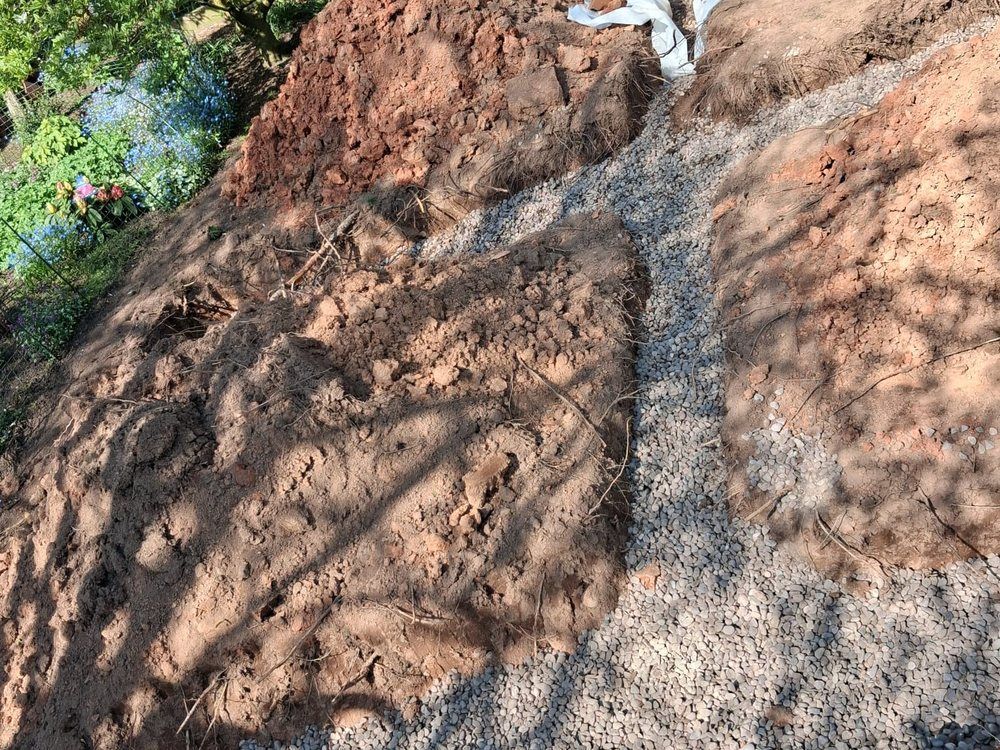
Perforated pipe in membrane-lined trenches filled with washed stone, cut to a fall that survives settlement.
Branch runs into a central spine, for a lawn that holds water across its full width.
One intercepting line, where the water is arriving from a single direction rather than everywhere.
Soakaways
Crate systems sized against a percolation test and set the required distance off the house and boundary.
Soakaway replacement
Silted crates and rubble pits dug out and rebuilt, rather than a second one added alongside.
Subsoil decompaction
Breaking up the pan left by construction plant, which on new estates is frequently the whole problem.
Levels and falls
Patios and paths reset so they shed water away from the building rather than towards it.
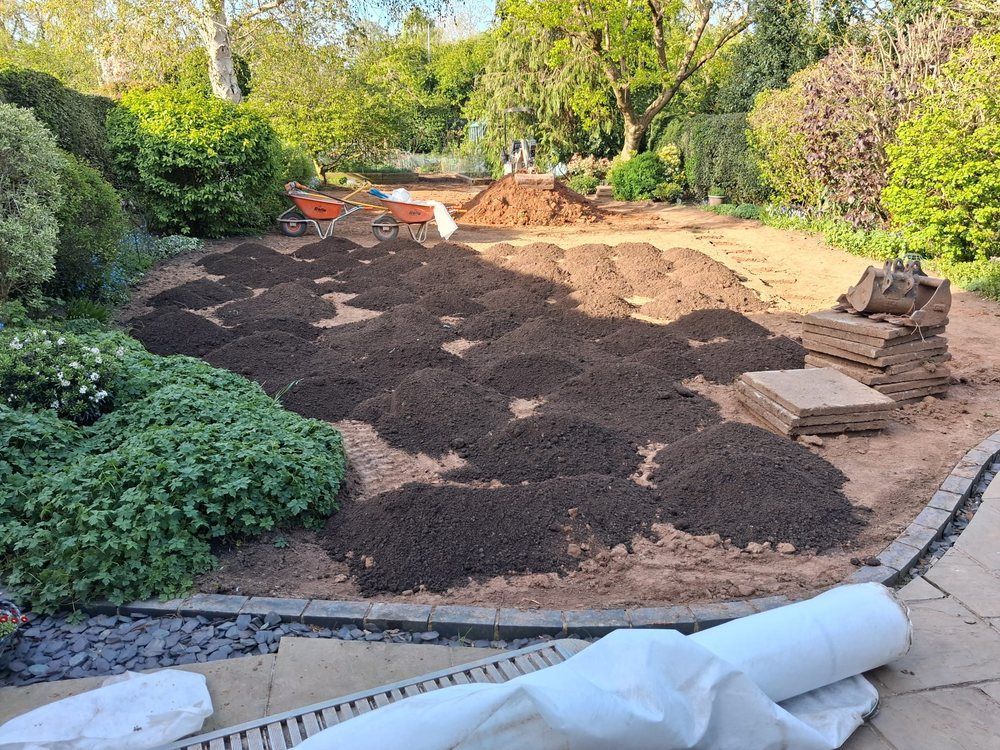
Screened soil, fresh turf and borders made good, so the garden is handed back finished.
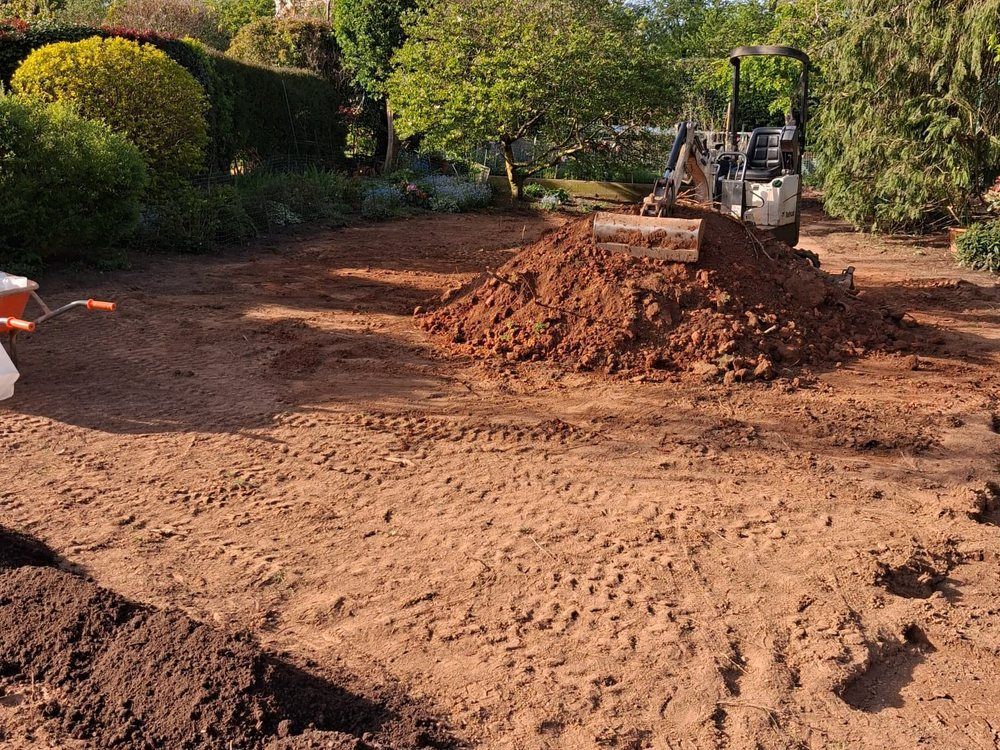
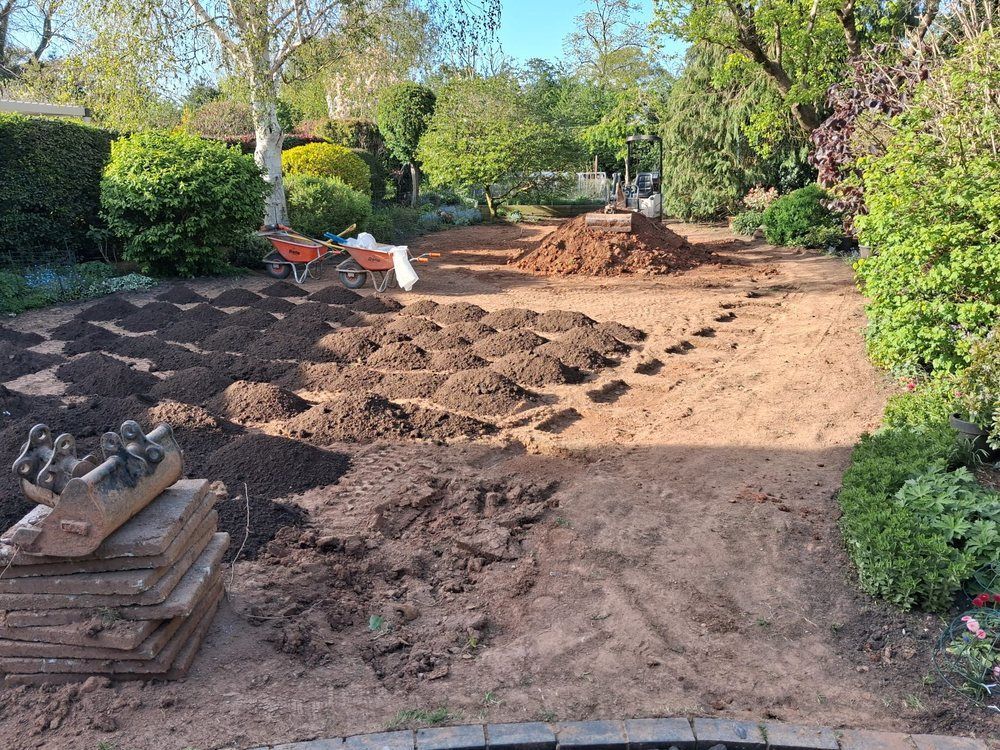
A drainage scheme through the build
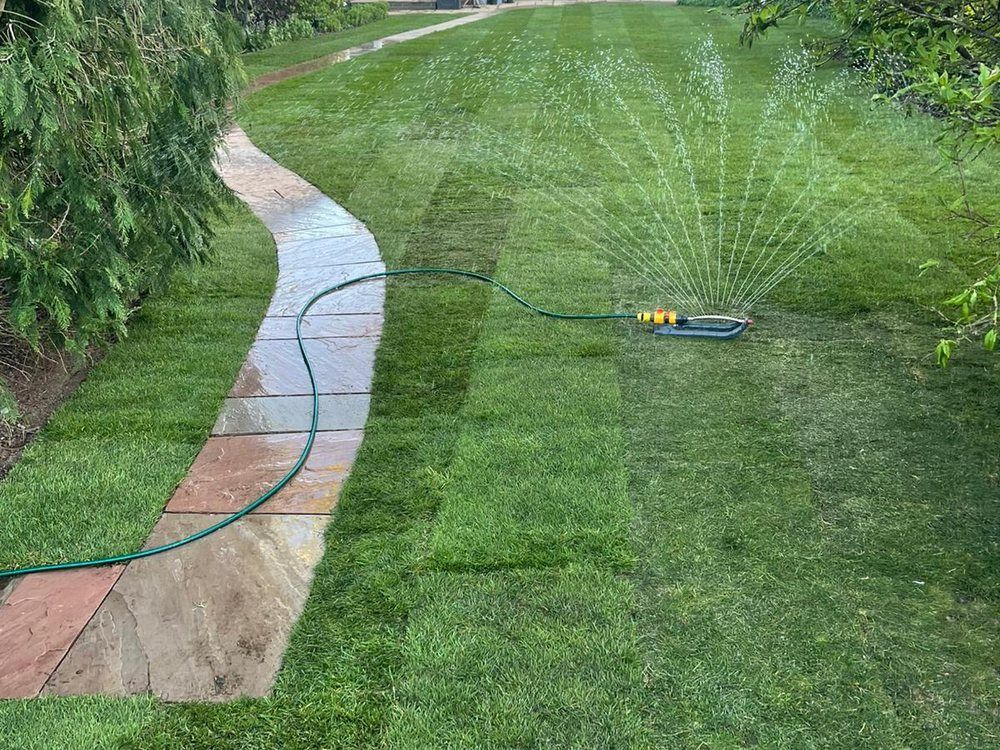
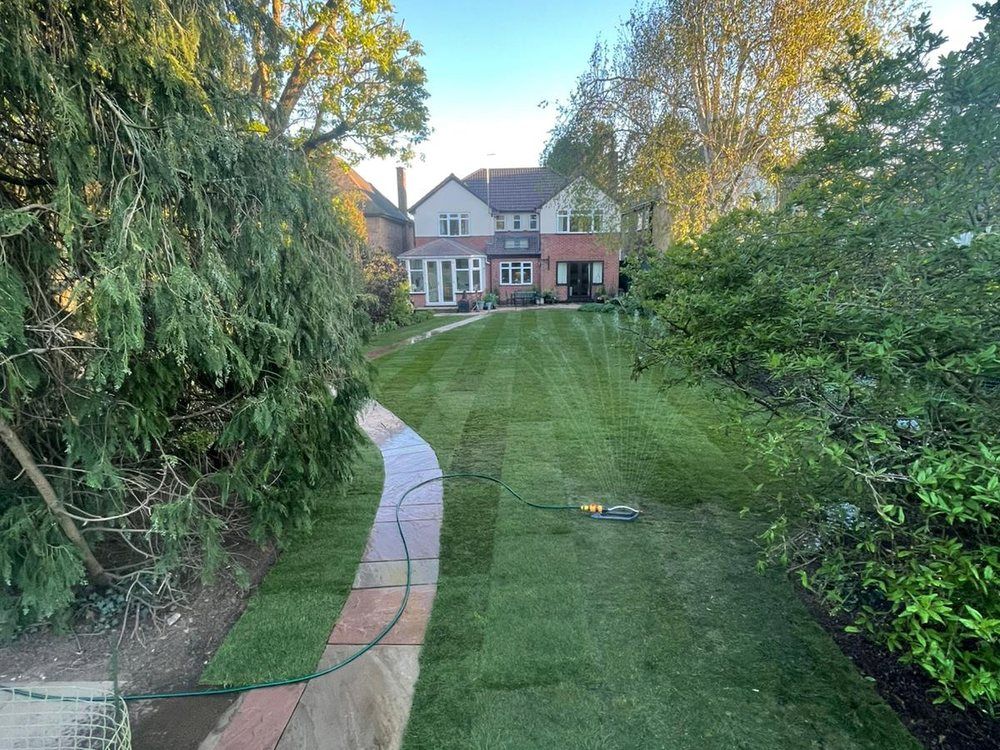
Photographs from a recent job at Kenilworth. Different town, same Warwickshire clay and the same sequence of work from first trench to finished lawn.
Why so many Rugby gardens never drained from day one
Houlton, Cawston, Coton Park and the smaller developments around them were built on farmland, and the sequence is the same on every site. Heavy plant works the ground for months and compacts the subsoil into something close to a pavement. Topsoil is spread over the top, often only a few inches of it. Turf goes down, the garden looks immaculate on handover day, and the first wet autumn reveals that there is nothing underneath for water to go into.
Three things follow from that, and they matter for how a scheme is designed. The clay itself may not be the main problem — the compaction layer above it often is, and breaking that up changes the picture. Buried construction debris is common, from broken block to offcuts of pipe, and it shows up mid-trench. And the garden levels were set by the builder, frequently falling gently towards the house or towards a fence rather than away from either.
The older streets nearer the town centre are a different proposition entirely: settled ground, established gardens, and drainage problems that are usually about a failed outlet rather than a compacted base.
On a newer house, check who is responsible before you pay anybody
This is the advice that occasionally costs us a job, and we would rather give it than not.
Before commissioning drainage on a recent new build
- The builder has a defects period. Most new homes come with a period during which the developer remains responsible for putting right work that was not done properly, typically the first two years. A garden that has never drained may fall inside it.
- The warranty provider has a complaints route. If the developer will not engage, the warranty scheme attached to the house usually has a resolution service. It is slow, but it is free.
- Some estate drainage is not yours to alter. Newer developments often include engineered drainage features — basins, swales, filter drains — that are managed by the developer, a management company or the authority. Connecting into them, or altering them, is not a decision for a homeowner or their landscaper.
- Get the ground tested either way. A percolation test and a trial hole give you evidence, whether you use it to instruct us or to put to the developer.
We are landscapers rather than surveyors or solicitors, and the terms of any individual warranty are a matter for the documents that came with the house. What we will say plainly at survey is when a garden looks like a builder problem rather than a landscaping one.
What we do about compacted new-build ground
Where the subsoil has been squeezed into a pan, drainage pipe alone can disappoint. Water has to be able to reach the trench in the first place, and a compacted layer prevents that as effectively as it prevents anything else.
So the sequence is usually: establish the depth and extent of compaction from a trial hole, break it up mechanically across the affected area, install the collection system into ground that can now feed it, and then deal with the destination — a soakaway where the tested ground allows one, or a connection or routed outlet where it does not. Topsoil depth is checked and made up where the builder was mean with it, because four inches of soil over broken clay grows a disappointing lawn even once it drains.
The construction detail is the same as anywhere: geotextile between soil and stone, washed aggregate, perforated pipe, consistent fall. There is more on the methods on our garden drainage page, and the clay soil guide explains what the ground is doing.
What the quotation depends on
- Whether decompaction is needed. On an estate garden this is often the largest single element, and it is also the one most competitors leave out.
- Where the water goes. An available surface water connection is the cheap answer; a tested and sized soakaway is not.
- Access. New estate gardens frequently have narrow side passages and no rear gate, which decides whether a machine can work.
- Topsoil. If the builder laid three inches, making it up to a workable depth is an extra cost worth paying.
- Spoil. Clay is heavy, cannot be spread on the garden, and leaves by lorry.
After the survey you get one figure covering the crew, the plant, the excavation, all materials, spoil removal and reinstatement.
Why Rugby clients use us
On estate gardens the temptation is to lay pipe and hope. We would rather find out why the ground is behaving as it is.
We check whether it is even your bill
If a garden looks like a developer defect we will say so, before you spend money that somebody else may owe you.
Compaction is treated, not ignored
Pipe laid into ground that water cannot reach will underperform. Breaking up the pan is part of the design, not an upsell.
Trial holes on every job
Two gardens on the same estate can behave completely differently depending on where the plant tracked.
Established and insured
Working across Warwickshire since 2015, with £1M public liability and 40+ years of combined experience.
Drainage in the surrounding area
Frequently asked questions
Do you cover Rugby and the surrounding villages?
Yes. We work across Rugby including Houlton, Cawston, Coton Park and Bilton, and out to Dunchurch, Long Lawford and Ryton-on-Dunsmore, as well as Warwick and Leamington Spa.
Our new-build garden has never drained. Is that the builder's problem?
It may well be, and it is worth establishing before you pay anyone. New homes come with a period during which the developer remains responsible for defective work, usually the first two years, and the warranty attached to the house generally has a complaints route if the developer will not engage. A trial hole and a percolation test give you evidence either way. We will tell you honestly if a garden looks like a builder problem.
What is subsoil compaction and why does it matter?
Months of heavy plant moving over a site squeezes the subsoil into a dense layer that water will not pass through. Because it sits above the natural clay, it stops water reaching a drainage trench at all, which is why pipe laid into compacted ground can disappoint. Breaking it up mechanically across the affected area is usually part of the fix rather than an optional extra.
There is a drainage basin on our estate. Can we connect to it?
Not without asking, and the answer is frequently no. Engineered drainage features on newer developments are managed by the developer, a management company or a public body, and altering or connecting into them is not a homeowner decision. We would need to know who holds it before designing anything that relies on it.
Is a soakaway the answer on a Rugby estate garden?
Sometimes, but it has to be tested rather than assumed. Ground that has been compacted and then had a soakaway dropped into it can fill and stay full. Where the test comes back well we will use one; where it does not, the water needs collecting and taking somewhere that can receive it.
How much topsoil should a garden have?
More than most new builds are given. A lawn wants a reasonable working depth of soil to root into, and a few inches spread over compacted clay produces grass that struggles in dry weather as well as wet. Where the depth is short we make it up as part of the reinstatement, and we will tell you at survey if that is the case.
What does garden drainage cost in Rugby?
It depends most on whether decompaction is needed and where the water is allowed to go, which is why we survey first. Once the ground has been opened the quotation is fixed and covers the crew, the machine, excavation, materials, spoil removal and putting the garden back.
New-build garden in Rugby that will not drain?
Tell us when the house was built and where the water sits. We will open the ground and tell you what is actually wrong with it.
