If you've searched for a fix for a waterlogged garden, you'll have come across the French drain. It's one of the systems we install most often on Coventry and Warwickshire clay, and when it's designed properly it works very well. But it isn't the answer to every wet garden, and a badly built one can be money down the drain, quite literally. Here's an honest look at both sides.
What a French drain actually is
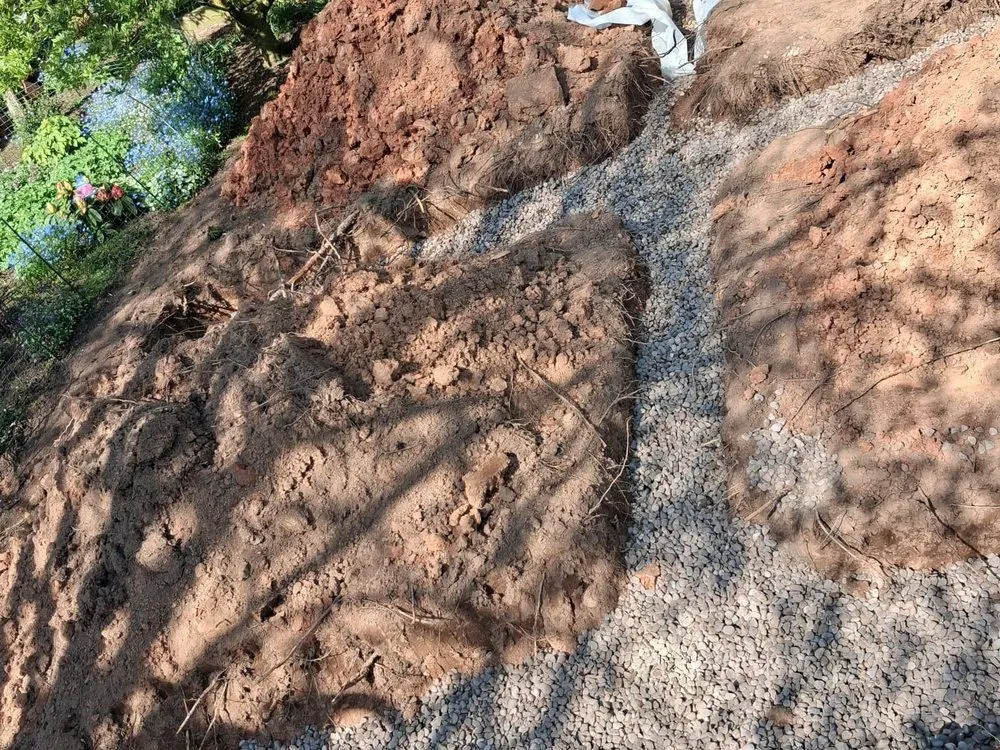
A French drain is a trench lined with a geotextile membrane, with a perforated pipe in the bottom and washed stone around and above it. Water in the surrounding ground finds its way into the stone, enters the pipe through its slots and runs along it, carried by the fall of the trench, to an outlet.
That last part is the key. A French drain doesn't make water disappear. It collects water and moves it somewhere else.
The pros
- It's invisible once finished. The trench is backfilled and turfed or planted over, so there's nothing to see.
- It works on clay. Because it intercepts water below the surface and gives it a route out, it deals with the problem clay causes rather than masking it.
- It lasts. Built with the right stone and membrane, a French drain needs very little looking after for many years.
- It can be targeted. A single run along a boundary or the bottom of a slope can solve a lot, without digging up the whole garden.
The cons
- It needs somewhere to send the water. Without a working outlet, such as a correctly sized soakaway or a surface water drain, a French drain on clay simply fills up and stays full. This is the most common reason they fail.
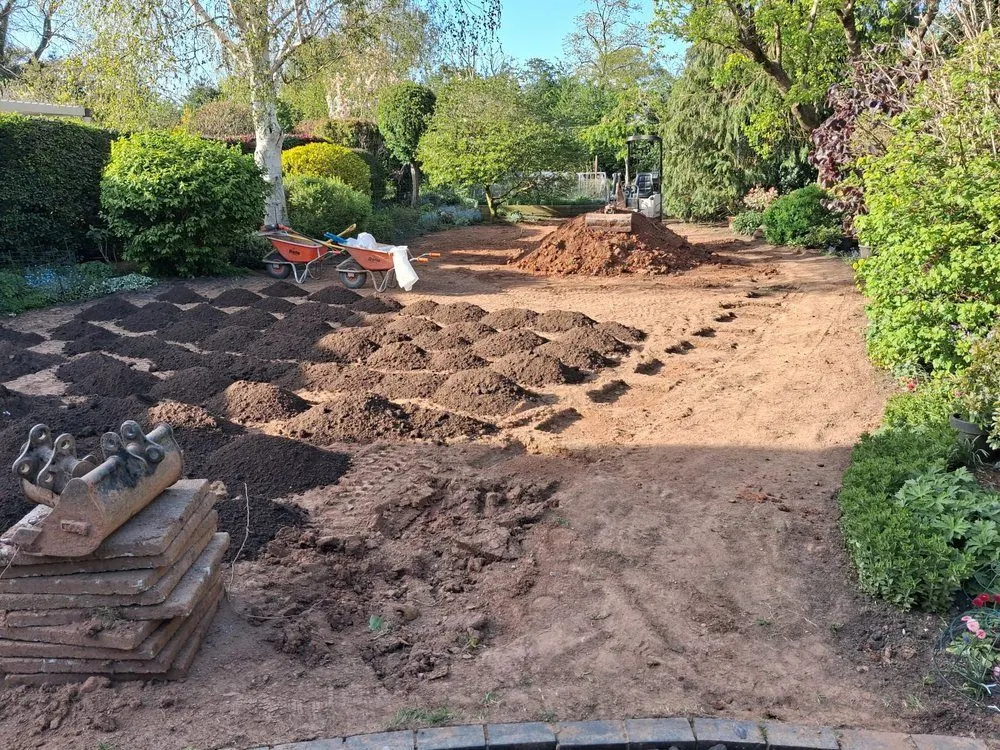
- It's disruptive. Trenches cross the lawn, spoil has to be taken away, and for a few days the garden looks worse than before.
- One run won't drain a whole lawn. If the entire area holds water, you need a network, often a herringbone layout, not a single trench.
- It can silt up. Without a membrane, fine clay particles wash into the stone and gradually block it.
- It's not cheap to do properly. Clay is heavy and can't be spread on the garden, so every load leaves by lorry, and access makes a big difference to the labour.
Why so many French drains fail
When we're called to a drain that "never worked", it's usually one of the same few mistakes:
- No real outlet. The pipe ends in a hole full of gravel that fills on the first wet day.
- No fall, or the wrong fall. Water moves because of gradient, not because the trench is deep. A shallow run laid to a true fall will move more water than a deep one sitting level.
- The wrong stone. Washed stone of a consistent size keeps open spaces for water. Crusher run and as-dug gravel pack down and don't.
- No membrane. Without geotextile between the clay and the stone, the drain silts up.
- Pipe the wrong way up. The slots need to face the right way to take water in.
How deep should a French drain be?
There's no single right depth. It needs to sit below the layer that's holding water and below the root zone of the lawn, but, more importantly, it has to fall continuously to its outlet. Getting the fall right matters more than digging deeper.
When a French drain isn't the answer
If there's nowhere legitimate for the water to go, a French drain alone won't fix the problem, and we'll tell you so. Sometimes the right answer is a soakaway sized from a percolation test, sometimes a change of levels in the beds, and occasionally a combination. Mild compaction on ground that otherwise drains may only need aeration.
Getting it designed properly
We design every scheme from a measured percolation test rather than a guess, and all our drainage work carries a 12-month workmanship guarantee. Find out more on our garden drainage page, read why clay soil causes these problems, or call 0247 512 2714 to arrange a survey.