One of the most common calls we get about waterlogged gardens in Coventry and Warwickshire starts with the same sentence: "It's all coming from next door." If your garden sits lower than your neighbour's, rain will naturally make its way downhill to you, and on heavy clay it has nowhere to go once it arrives. Here's what you need to know, and what can be done about it.
This is general information, not legal advice. If you're in a dispute with a neighbour, speak to a solicitor or Citizens Advice.
Natural run-off and channelled water are treated differently
In England, the general position is that water which flows naturally from higher ground onto lower ground is something the lower owner has to accept. If your garden is downhill from next door, rain running off their lawn and across the boundary is not usually something they're responsible for.
Water that has been collected and directed onto your land is a different matter. A downpipe emptying onto the boundary, a new patio or drive laid to fall towards your fence, or a drain discharging over the boundary can all be treated very differently from water that arrives there by itself. It's the same principle we work to on our own jobs: we never design a scheme that channels collected water onto a neighbour.
Check the cause before anything else
Before assuming the worst, it's worth working out where the water is really coming from. A few things to look at:
- When does it happen? Water that only appears in heavy rain points to surface run-off. Water that's there in dry spells may be a leak or a high water table.
- Where does it enter? Walk the boundary during rain. A single wet spot often lines up with a downpipe, gully or paved area on the other side.
- Has anything changed? New paving, an extension or a raised lawn next door can change how water moves.
- Is it clean water? Anything that smells or looks like waste water is a drainage fault that needs reporting to the water company or the council, not a garden problem.
If the cause is a broken downpipe or a blocked gully next door, a friendly conversation usually sorts it far faster than anything else.

Fixing it on your side of the fence
Where the water is simply natural run-off from higher ground, the answer is to deal with it once it reaches you. That usually means one or more of these:
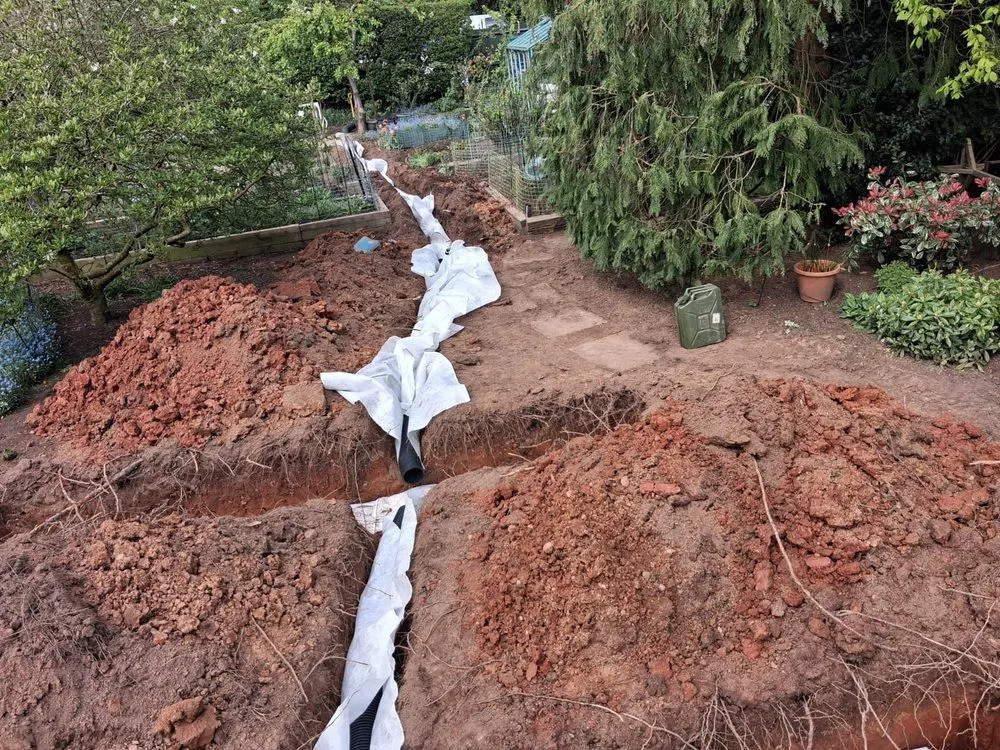
- A cut-off drain along the boundary. A gravel-filled trench with a perforated pipe, laid to a fall, intercepts water as it arrives and carries it away before it spreads across your lawn.
- Land drainage across the garden. Where the whole lawn holds water, a herringbone layout collects it from across the area.
- Somewhere for the water to go. Collected water has to end up somewhere legitimate: usually a soakaway on your own land, sized from a percolation test, or an existing surface water drain.
What we won't do is simply raise your garden to push the water back. Raising levels can move the problem against your house, and it can send water onto someone else, which just passes the dispute along the street.
Why clay makes it worse
Much of Coventry and Warwickshire sits on heavy clay, which barely lets water through. On free-draining soil, a neighbour's run-off soaks away within hours. On clay it sits on the surface, and a lawn on the low side of a boundary can stay waterlogged for weeks. Our clay soil garden solutions page explains why in more detail.
Getting it looked at
We start every drainage job by working out where the water is coming from and testing how quickly your ground will take it, then design a scheme around that. If we don't think a scheme will work, we'll tell you rather than take the job. See our garden drainage solutions page, or call 0247 512 2714 to arrange a visit.