
Soakaways and Garden Drainage in Solihull
Drainage for large, mature gardens, designed around the trees rather than through them
Solihull gardens tend to be older, larger and considerably better planted than average, and that changes the drainage problem in a way most contractors do not allow for. A trench in an open lawn is straightforward. The same trench through the root plate of a mature beech is a different decision entirely, and occasionally an illegal one.
Drainage work we carry out in Solihull
Membrane-lined trenches, washed stone and perforated pipe, routed to avoid what should not be cut.
Soakaway installation
Crate systems sized from a percolation test and positioned with buildings, boundaries and trees all accounted for.
Soakaway replacement
Old pits and silted crates excavated and rebuilt, which is what most failures actually need.
Branch runs into a spine, where a whole lawn is affected rather than a corner of it.
A single intercepting line where water arrives from one direction, such as a slope or a drive.
Drainage around mature planting
Hand-dug routes, root bridging and design changes that keep a significant tree alive.
Levels and falls
Terraces and paths reset so water runs away from the house rather than collecting against it.
Lawn, borders and hard landscaping restored to the standard the garden was at before.
How the work is built
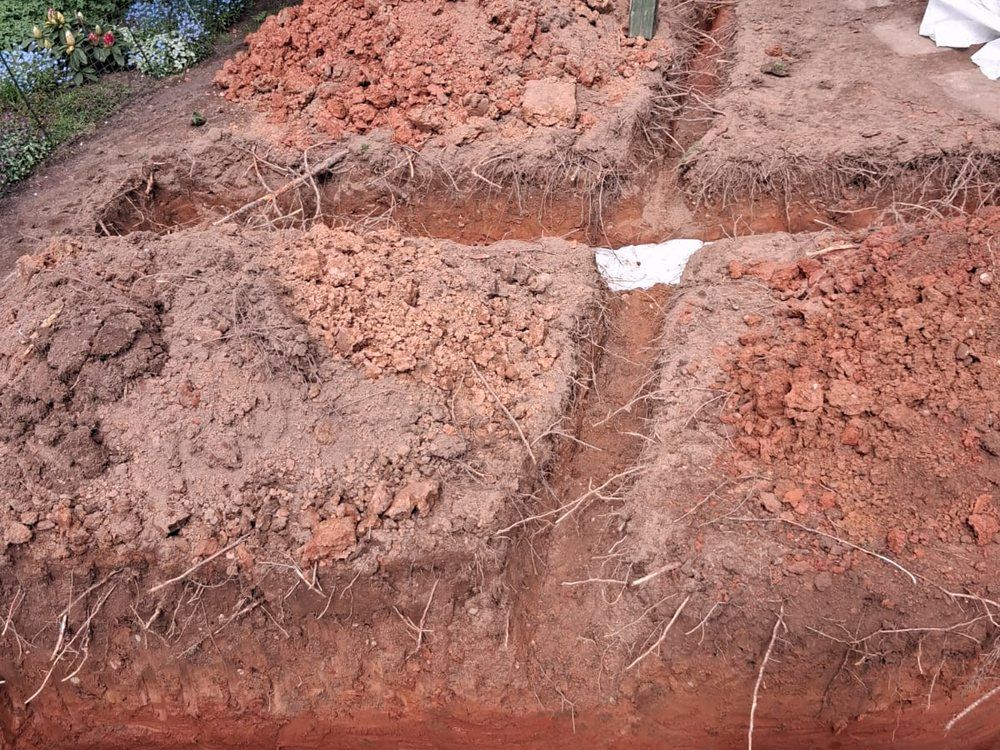
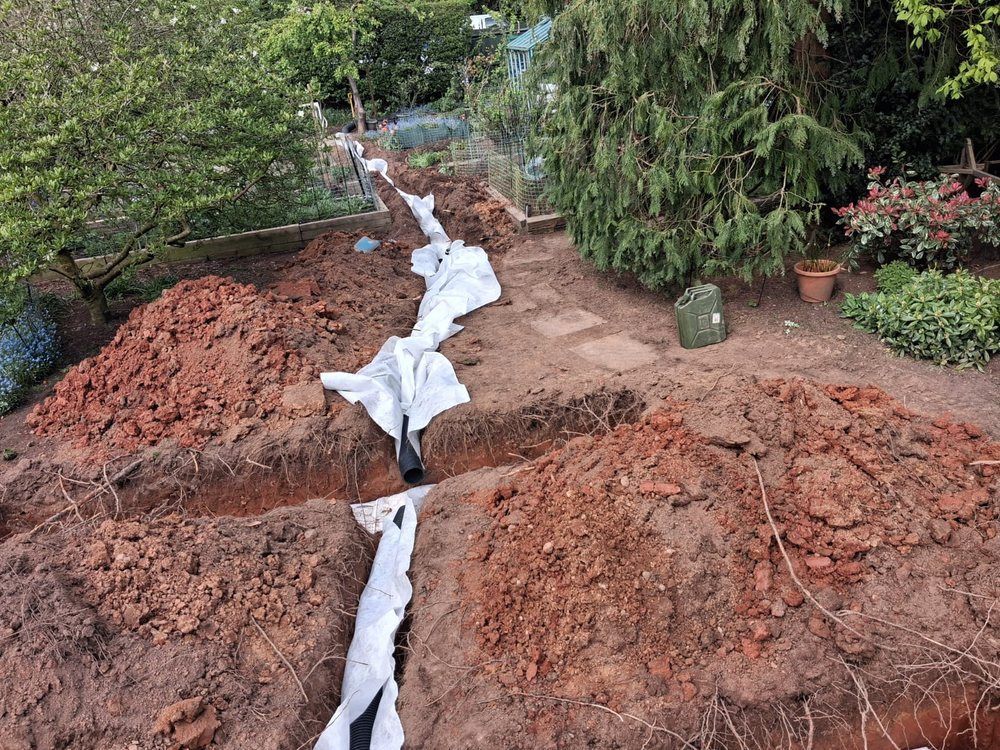
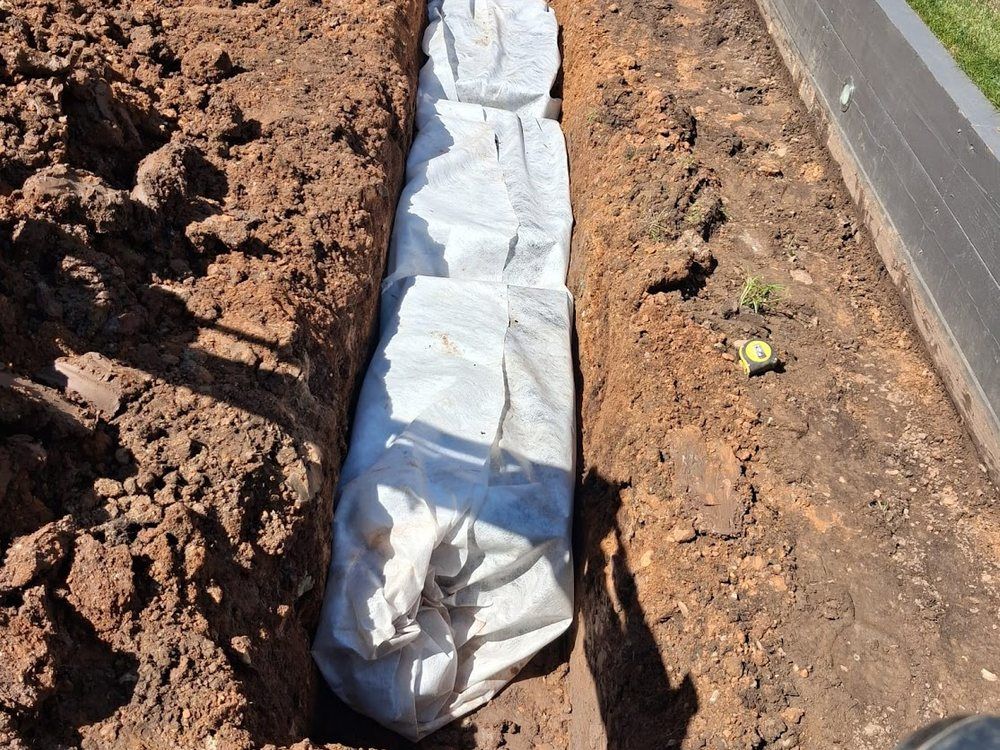
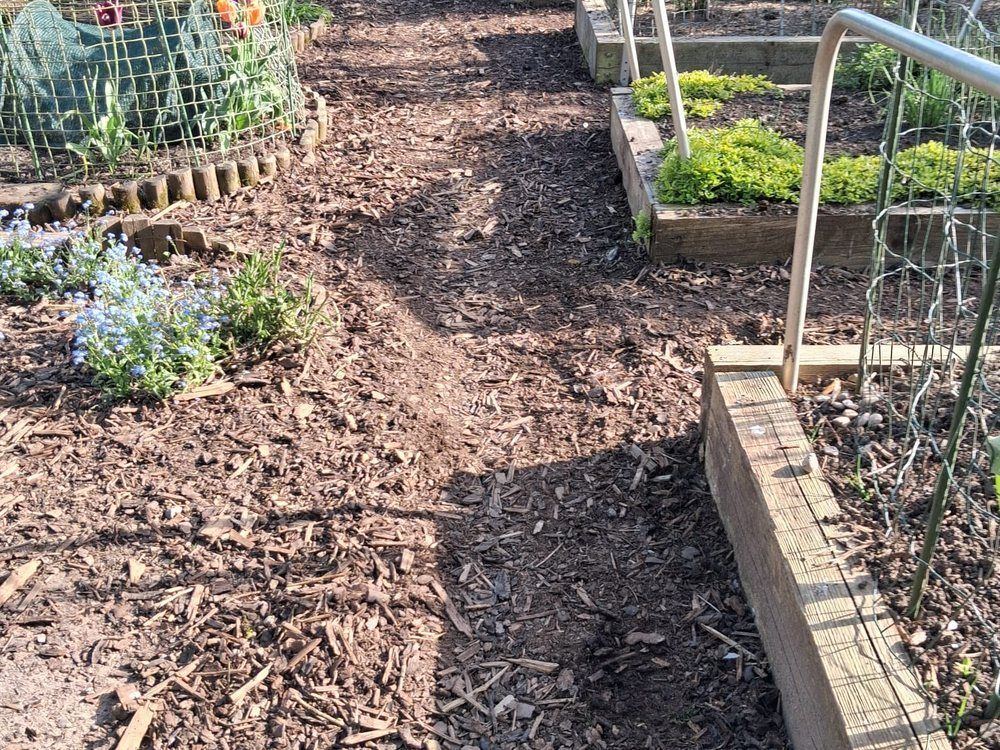
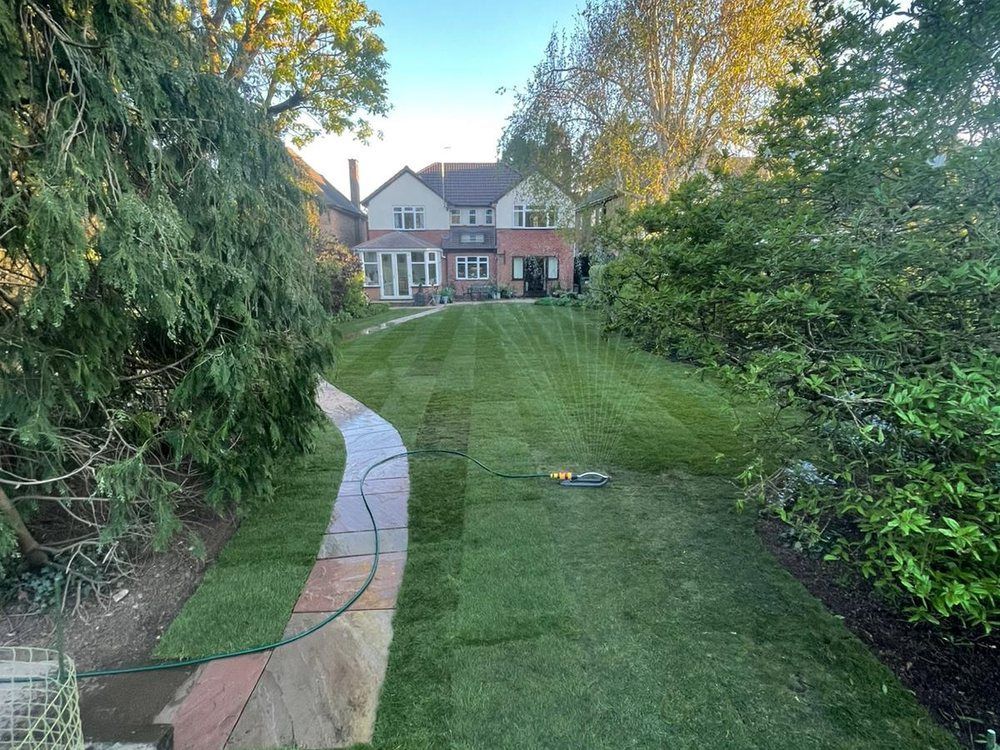
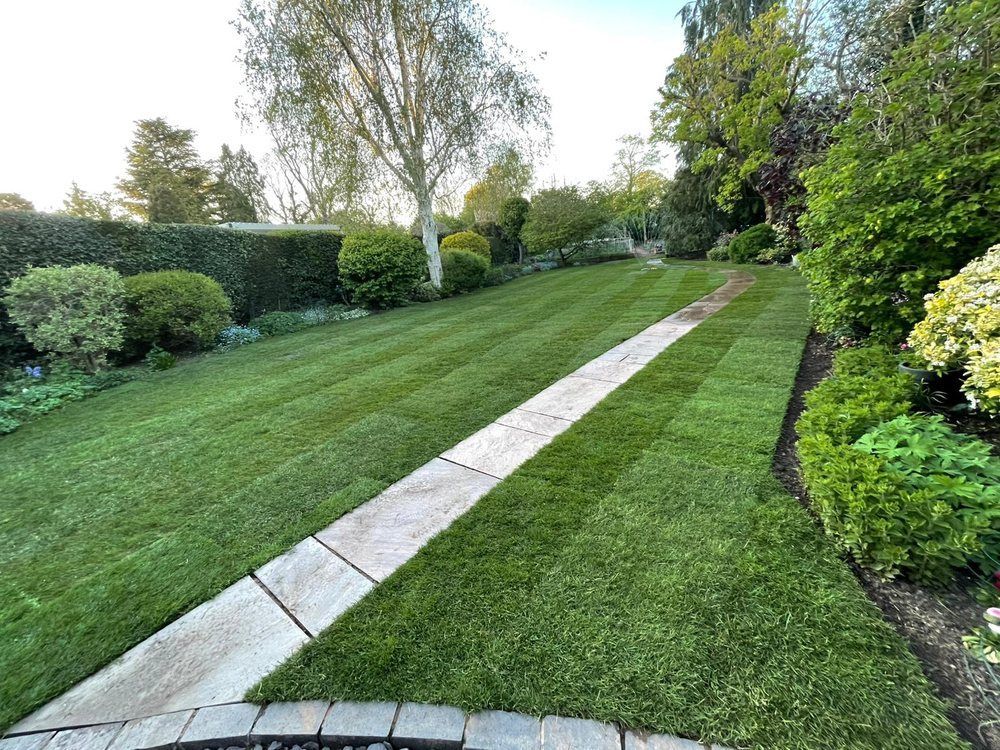
A recent scheme at Kenilworth, photographed through the job. The garden is comparable in scale to much of what we drain in Solihull and the method is identical.
Large gardens, heavy clay and a great many trees
The ground under most of Solihull is the same stiff clay that runs across the region, and on its own it explains why so many lawns here sit wet from November onwards. What makes the borough distinctive is everything growing on top of it.
Gardens in the older roads, and in the villages around the town, carry mature specimen trees, substantial hedging and planting that has been established for decades. That has two effects on drainage. Through summer, a large tree removes a remarkable volume of water from the soil, which is why a garden can be firm in August and impassable by December — the tree stops drinking and the clay has no other way of shedding what arrives. And the root systems occupy exactly the ground a drainage run wants to cross.
The practical consequence is that a drainage design here starts with a walk round the trees, not with a line on a plan.
You may not be allowed to dig where the pipe wants to go
This catches people out because it is a tree question rather than a drainage one, and nobody thinks to ask it until the mini digger is on site.
The general position in England
- Protected trees cannot be worked on without permission. A tree covered by a Tree Preservation Order requires the council’s consent before works, and cutting roots can count as works.
- Conservation areas have their own rule. For a tree in a conservation area, six weeks’ written notice to the council is generally required before works, with an exemption for trunks of 75mm or less measured at 1.5 metres from the ground.
- Doing it anyway is an offence. Unauthorised works to a protected tree carry the possibility of prosecution, and the fact that the damage was done by a trench rather than a chainsaw is not a defence.
- The biology matters as much as the law. Guidance on construction near trees works to a root protection area with a radius of roughly twelve times the trunk diameter. Trenching through that zone can kill a mature tree several years later, long after anyone connects the two events.
We are landscapers, not arboriculturists or solicitors, and this is the general position rather than advice about a specific tree. Where a garden has significant or possibly protected trees, the sensible order is to find out their status first, then design a route around them — hand-dug sections, bridged roots and a slightly longer run are all far cheaper than the alternative.
Designing a scheme round what is already growing
Once the trees are accounted for, the rest follows the usual sequence. A trial hole and a timed percolation test establish what the ground will accept, which decides whether a soakaway is viable and how large it needs to be. Trenches are then routed to collect the wet ground while staying outside the zones that must not be disturbed.
Where a run genuinely cannot avoid a root area, the work is done by hand rather than by machine, roots of any size are bridged rather than severed, and the trench is backfilled promptly. It is slower and it costs more, and it is the difference between a drained garden and a drained garden with a dead tree in it.
Construction detail is unchanged: geotextile between soil and stone, washed aggregate, perforated pipe, a consistent fall and an outlet that can take the water. Our drainage service page sets out the methods, and the clay soil guide covers the ground itself.
What moves the figure on a larger garden
- How much of the run has to be hand-dug. Machine work is quick; hand work around root plates is not, and on a mature plot it can be a substantial share of the job.
- The area being drained. A large lawn needs more collection than a small one, and the soakaway is sized from what feeds it.
- The outlet. An available surface water drain is the cheap answer. A tested, sized soakaway on a big garden is a significant excavation in itself.
- Protecting what is there. Established borders, specimen planting and laid stone all need care rather than speed.
- Reinstatement standard. Putting a garden of this quality back so it does not look disturbed takes longer than turfing a lawn.
The figure quoted after the survey covers the crew, the plant, the excavation, all materials, spoil removal and full reinstatement.
Why Solihull clients choose us
On a garden that has taken thirty years to reach this point, the risk is not the drainage failing. It is what the drainage work does to everything around it.
We look at the trees first
Their status and their root zones shape the route. Designing the pipe run and discovering the problem afterwards is the wrong order.
Hand-dug where it needs to be
Slower, dearer, and the reason a mature specimen is still standing in five years.
Designed from a test, not a guess
Soakaway sizing on a large garden is arithmetic, and the input is a timed percolation test.
Finished to the standard it started at
Borders, lawn and hard landscaping restored properly. A drained garden that looks excavated is not a finished job.
Drainage in neighbouring areas
Frequently asked questions
Which parts of Solihull do you cover?
The borough and the villages around it, including Knowle, Dorridge, Hampton in Arden, Balsall Common and Lapworth, as well as the Solihull suburbs themselves. Larger gardens are the bulk of what we do in this area.
There is a big tree near where the drainage needs to go. Is that a problem?
It is a consideration rather than a barrier. The first question is whether the tree is protected, by a Tree Preservation Order or by being in a conservation area, because that changes what is permitted. The second is biological: trenching through a root protection area can kill a mature tree years later. Both are solvable with a route change, hand digging or bridging, and all three are cheaper than losing the tree.
How do I find out whether a tree is protected?
The council holds the records for Tree Preservation Orders and will confirm whether a property sits in a conservation area. It is worth asking before work is planned rather than after, and it costs nothing. We will raise it at survey if a garden looks likely to be affected.
Why is my garden fine in summer and waterlogged in winter?
Very often the trees. A mature tree draws a substantial volume of water out of the soil through the growing season, and on clay that is frequently the only thing keeping the ground workable. When it stops in autumn, the clay has no other route and the water stays. It is not a sign that anything has changed, only that the ground was always this way.
Can you install a soakaway in a large garden, or is it too much water?
Volume is not usually the obstacle; ground permeability is. A soakaway on a big garden is sized from the area draining into it and the rate the ground accepts water, established by a percolation test. On stiff clay that arithmetic sometimes says no, in which case the water needs collecting and routing elsewhere.
Will the lawn and borders be put back properly?
Yes, and it is part of the same contract rather than something arranged separately. We are a design-and-build landscaping company, so reinstating a garden to the standard it was at is the work we normally do, not an afterthought.
What does garden drainage cost in Solihull?
There is no useful average for gardens of this size, because the same scheme can be machine-dug in a week or hand-dug over three. We survey, test the ground, look at the trees, and then give one figure that covers everything through to reinstatement.
Large garden in Solihull sitting wet?
Tell us what the garden does through the winter and what is growing in it. We will come and look at the ground and the trees together.
